The “Forever Home” Myth: Some Guidance for Your Next Chapter (and Your Best Options)
Swampscott homeowners, staying isn’t about refusing to change. It’s about being deeply attached to a life you’ve built. A home holds decades of meaning: holidays, milestones, and the role of being the “home base” for family gatherings. The neighborhood is part of that identity, too — familiar streets, routines, neighbors you’ve known for years, and the simple comfort of knowing exactly how your house works (even its quirks). Downsizing can feel less like a real-estate decision and more like closing a chapter. People worry they’ll regret leaving a place that has shaped their daily life.
Most sellers underestimate the energy required to move—physical, mental, and emotional. It usually doesn’t hit you until you’re sorting, scheduling, and making a hundred decisions a day. Downsizing means a thousand micro-decisions like what to keep, sell, donate, fix, store, or toss and that can be emotionally heavy. Add in the logistical drag of showings, repairs, paperwork, inspections, movers, and timing the next home, and staying becomes the default. Even homeowners who want to move can stall out simply because the process feels like a full-time project.
A final layer is the “where would we go?” problem. Condos and smaller homes come with tradeoffs — HOAs, shared walls, parking and storage realities, and a different sense of control. When the alternative is uncertain, the current home wins by familiarity. Most people aren’t “lazy.” They’re human: attached to what they love, and reluctant to take on a process that feels disruptive, exhausting, and full of unknowns.
According to ATTOM’s Q4 2025 homeownership tenure report, Massachusetts homeowners stay in their homes for an average of about 13.29 years, the longest tenure of any state — that’s a clear indication that we are reluctant to leave home! Read more about homeownership tenure in Massachusetts.
“And if that all sounds like… a lot, you’re not being dramatic — you’re being accurate.”
But, as life changes, needs change. How do you adjust to those changes…stay or go?
Suddenly the house that felt perfect doesn’t. So what’s the move: stay and make it work, or go find what works next? The real question is when that choice makes sense emotionally, physically, and financially.
Here’s why this gets hard: both choices can be smart, and both come with a “price.”
Renovating can keep you in the neighborhood you love, but it also means dust, decisions, and living in a construction zone for a while. Moving can feel like a clean reset, but it comes with its own pile of logistics — and yes, the math matters.
If you’re feeling torn, you’re not alone. Most homeowners aren’t stuck because they can’t decide — they’re stuck because they’re trying to weigh ten things at once in their head, which is a terrible place to store ten things.
That’s where my scorecard helps. It doesn’t “tell you what to do.” It just puts your priorities on paper so you can see which direction is actually winning for you — stay and right-size, or move and start fresh. (And if your totals are close, congratulations: you’re a normal person.) So, let’s look at the “next chapters” most homeowners choose:
- Stay + “right-size” renovation (first-floor living, safer stairs, better flow)
- Move small (condo or smaller single-family)
- Move + renovate the next one
- ADU with a family member — privacy-with-proximity, with shared maintenance costs and built-in support
Now, here’s the scorecard to help you sort out which lane fits you best.
As I’ve always told my kids, “The only thing constant in life is change,” as much as we may not want to embrace it. But I’ve found, in my 30-plus years of selling real estate — especially helping people downsize — that the most important part of the whole process is being genuinely excited about the next chapter. If you’re not excited about where you’re going, the whole plan falls flat. And wherever you land, knowing you’re happy and excited about that next place is what makes it all worthwhile — the sorting, the decisions, the logistics, all of it.
And if I can offer one piece of advice: give yourself plenty of time to explore your options. If you’re starting to think about your next chapter—even if it’s a year or two away—it’s worth having the conversation early. The more time you give yourself, the better your options become.
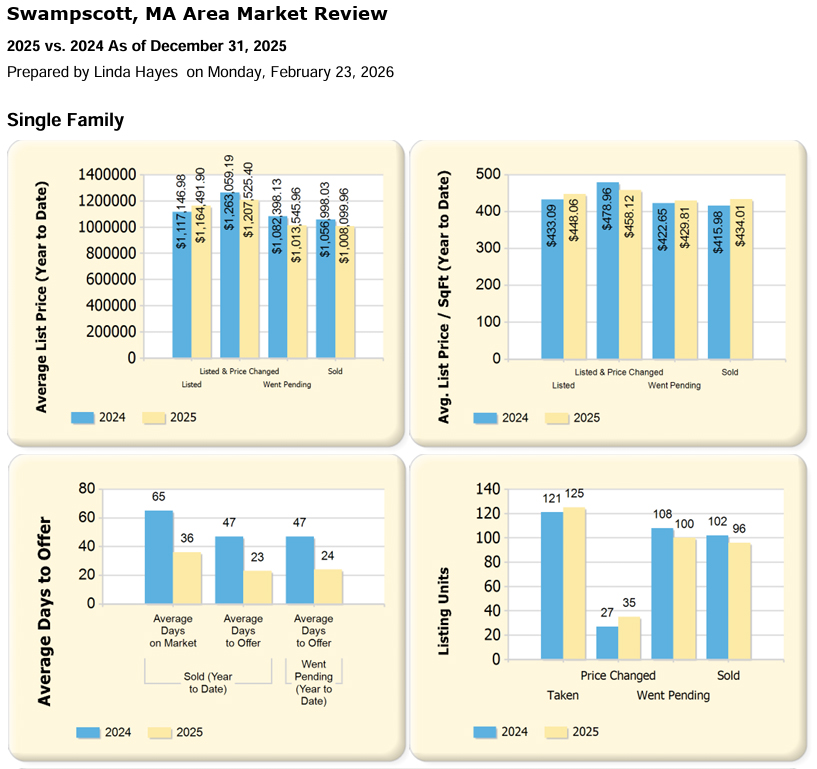
Curious what your Swampscott home is worth right now? Get a free market analysis — no pressure, just the numbers.


Linda Hayes, Realtor®, William Raveis Real Estate
C. 781-605-8805 O. 781.631.1199
Linda@HayesHouseandHome.com
hayeshouseandhome.com