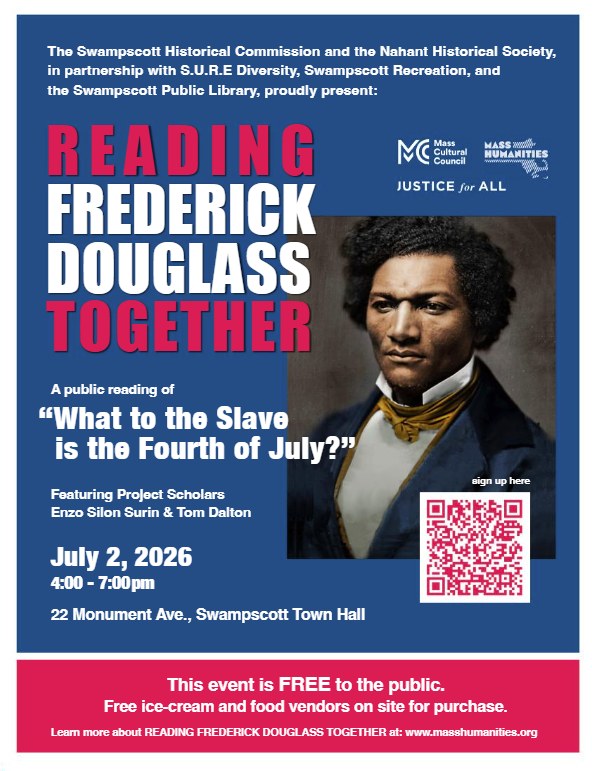
As the community prepares for the second annual reading of Frederick Douglass’ “What to the Slave Is the Fourth of July?”, author Tom Dalton said the speech showcases why Douglass was “such a brilliant man.”
“He was so honest in that speech,” Dalton said.
The free event on July 2 is sponsored by the towns of Swampscott and Nahant, along with Swampscott Unites Respects Embraces (S.U.R.E.) Diversity and the Swampscott Recreation Department, through a grant from Mass Humanities and the Mass Cultural Council. The event is meant to help people connect Douglass’ legacy with their community and American values.
Douglass was an abolitionist, writer and orator. He was one of the most prominent figures in the 19th-century African American civil rights movement. Dalton, who is a retired Lynn Daily Item reporter, started writing about Douglass in 1990 in hopes of informing readers about the abolitionist’s connection to Lynn, which included the area of Swampscott at the time. Dalton wrote “Frederick Douglass: The Lynn Years” after watching a documentary that mentioned Douglass’ connection to Lynn — something he said he “had no idea” about.
“What I realized was that everyone (in Lynn) had the best intentions but what they had on Douglass was not correct…I’m a big fan of Lynn and it’s got terrific history, but it’s been forgotten,” Dalton said. “I thought when I retired – and my wife wanted me to find something to do – I decided I would do a report on the primary sources.”
Later Dalton’s son encouraged him to turn his research into a book. Since then, he has given numerous talks about Douglass. He added that he may revisit the book and incorporate additional details after completing his current project.
Douglass arrived in Lynn – which Swampscott was a part of at the time – at age 23 in 1841 and lived there for six years, during which he wrote his influential autobiography, “The Narrative Life of Frederick Douglass.” A traveling speaker, Douglass’ family lived in the area, but he spent “about two-thirds of his time not here,” Dalton said.
When Douglass arrived in Lynn, he was a fugitive slave. Six years later, he left as a free man.
“He’s 23 years old, he’s got a wife and two kids, and he’s taken on this incredible responsibility of being a traveling speaker, which is a miserable, very hard job,” Dalton said. “When they traveled in the carriage, Douglass had to go on top. He was physically attacked. It was a difficult job.”
In one incident, Dalton said, a train displayed a sign stating that seating was at the conductor’s discretion. Douglass was ultimately thrown off the train.
That didn’t stop people, like Lydia Estes Pinkham, to become close friends with Douglass. Dalton said Estes Pinkham “famously walked down Broad Street with him arm-in-arm, and she dragged him in front of her church.” The church kicked Estes Pinkham out, but the newspaper “ran this terrific conversation between Estes and her minister.”
“He was a courageous guy,” Dalton said. “At some point somebody realizes ‘this man is much more intelligent than we are’ so there was a lot of friction.”
Because some doubted he had ever been enslaved — citing his manners and his abilities as a reader, writer and orator — Douglass decided to write his autobiography, “Narrative of the Life of Frederick Douglass.”
“He wrote this masterpiece, especially brilliant,” Dalton said. “It’s literally a criminal indictment of sorts, so when he finishes he has to flee (to England)…where he spoke at London taverns. Everybody wanted to hear him.”
A few years after leaving Lynn, Douglass delivered his famous Fourth of July speech, commenting on the hypocrisy of the American celebration of freedom while slavery still existed, and criticized the gap between American values of liberty and Black oppression.
“It’s a great speech,” Dalton said. “Congress just passed the Compromise of 1850, the fugitive slave laws (where escaped slaves were required to be returned to their owners)…For the Fourth of July speech, he says it’s such an honor, ‘I’m not sure I deserve it.’ He always starts that way, just softening you up. Then he does this thing where he praises the patriots and this country’s history and the fight for freedom and people have a reason to celebrate, but my God the hypocrisy of celebrating. He then just has several paragraphs which are so well done, such powerful denunciations of the hypocrisy…He said ‘how can you expect me to say on July 4 about celebrating.’”
The event will run from 4 to 7 p.m. on July 2, with free ice cream as well as food vendors on site for purchase. The Lynn Museum has also donated passes for attendees to visit its exhibit on Douglass.
The speech is divided into 60 sections, and S.U.R.E. Diversity is encouraging participants to read in teams this year to allow for broader participation. There will be a discussion following the reading as well.
Dalton will be a part of a panel during the event.
To sign up to read, visit https://www.signupgenius.com/go/10C044CA9AD28ABFFC34-64088572-frederick#/.