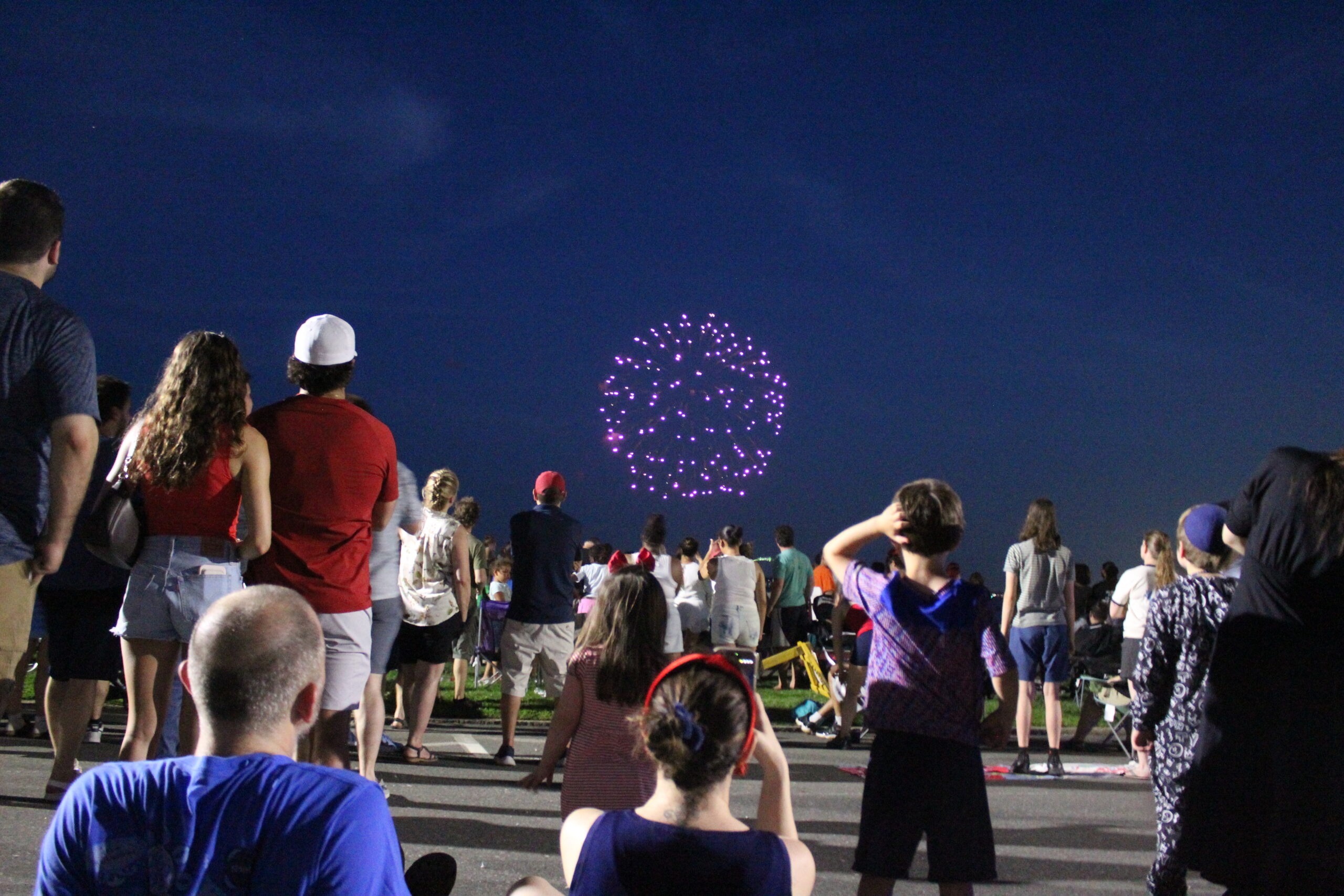
As the country celebrates its 250th anniversary and fireworks continue lighting up the sky throughout the summer, George Allen is calling for greater awareness of the pollution they produce.
“For the most part, it’s not a major concern. It’s a minor concern,” said Allen, chief scientist at NESCAUM. “It’s not good to breathe it…I don’t want to be sounding alarm bells here. It’s more a point of interest. Fireworks do cause air pollution.”
The 250th anniversary of the United States, often called the U.S. Semiquincentennial, marks 250 years since the adoption of the Declaration of Independence on July 4, 1776. The anniversary commemorates the nation’s founding and offers an opportunity to reflect on its history and ideals.
The tradition of celebrating with fireworks traces back to Founding Father John Adams, who wrote to his wife, Abigail, on July 3, 1776, that the country’s independence “(ought to be) solemnized with Pomp and Parade, with Shews, Games. Sports, Guns, Bells, Bonfires and Illuminations.”
The tradition of setting off fireworks on the Fourth of July began in Philadelphia on July 4, 1777, during a citywide celebration. Later that night, the Sons of Liberty launched fireworks over Boston Common.
Massachusetts banned consumer fireworks in 1943 as a World War II safety measure, and it remains the only state with a complete statewide ban on their possession, sale and use.
“On the fourth, there’s tons of rogue / illicit fireworks everywhere,” Allen said. “Swampscott’s just like every other town. They’re all over the state. That’s what happens.”
The Consumer Product Safety Commission reports that thousands of people visit emergency rooms each year around the Fourth of July with fireworks-related injuries. Large fireworks displays also typically produce significant amounts of fine particulate pollution.
Fireworks contain metals that create their vibrant colors. The resulting fine particles, known as PM2.5, can trigger asthma attacks because they penetrate deep into the lungs and can enter the bloodstream.
“I think there’s certainly a safety issue. People get injured by doing their own fireworks. It is illegal, but it’s not enforced,” Allen said. “Am I concerned about the air pollution? A little bit.”
A PurpleAir sensor in Swampscott, which measures hyperlocal air pollution, suggested particle pollution was elevated on July 4.
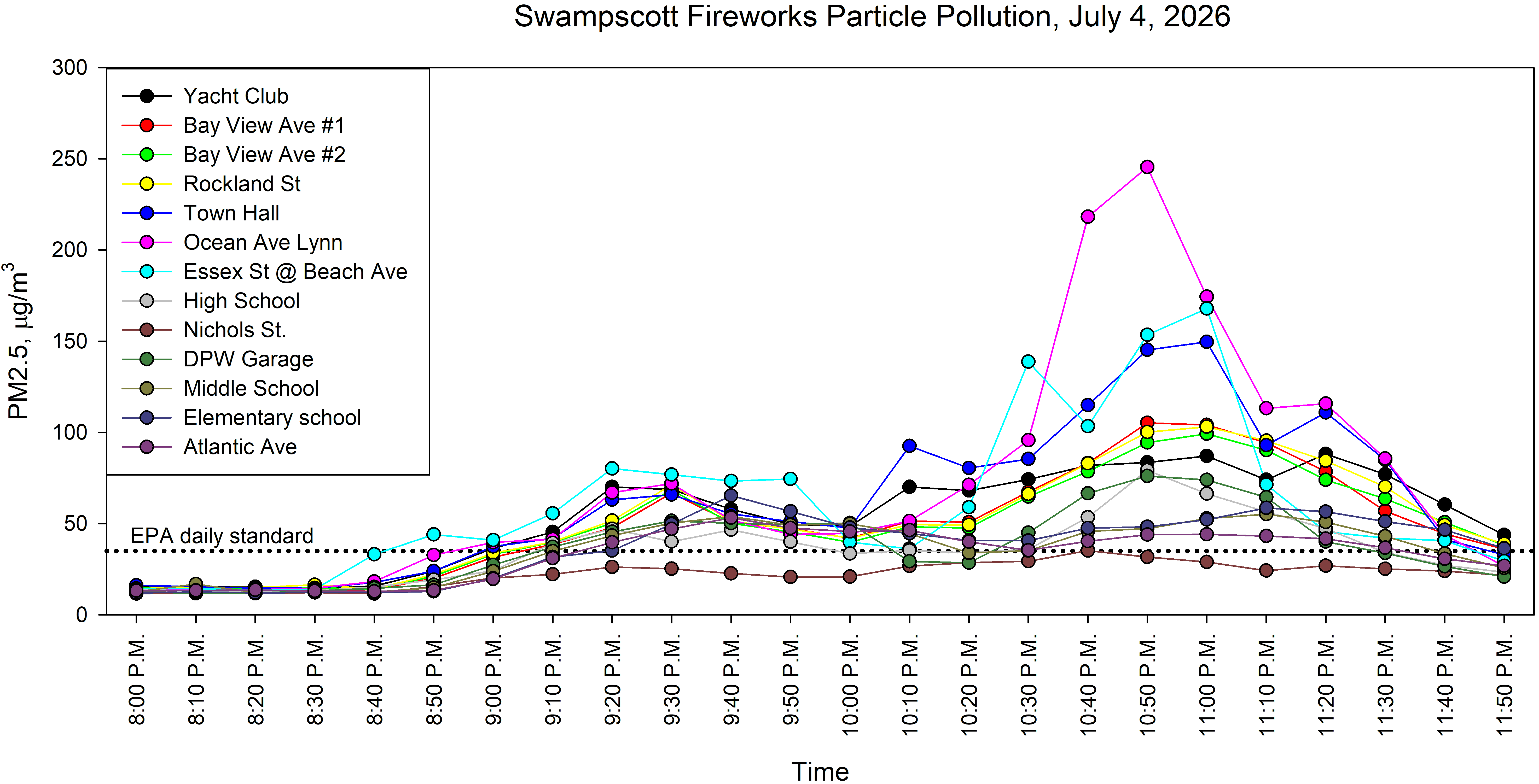
Areas around Essex Street and Beach Avenue, all three schools, Town Hall, Rockland Street, Bay View Avenue and even Ocean Avenue on the Lynn side exceeded the Environmental Protection Agency’s daily PM2.5 standard starting at about 9 p.m, through midnight.
“The levels were a little higher this year,” Allen said. “That depends on the weather and the wind. There were very loud fireworks going off throughout the neighborhood.”
Swampscott and Lynn’s municipal fireworks display on July 3 produced “barely any signal” on the sensor, Allen said.
“The wind was from the west, so the plume blew out into the ocean,” Allen said. “Had the wind been from the south, we might have seen it here.”
Even still, the particulate matter dissipates within a few hours, Allen said.
“It’s transient,” Allen said. “It doesn’t last for more than a few hours.”
For those who haven’t gotten their firework fix yet, there are still a few town- and city-sponsored events throughout Massachusetts scheduled for the rest of the month:
July 8 – Taunton at Hopewell Park at 9 p.m.
July 10 – Worcester at Polar Park Stadium after the game
July 11 – Boston at Fan Pier at 9 p.m.
July 11 – Clinton at Veteran’s Athletic Fields at 9:15 p.m.
July 11 – East Brookfield at the Old Landfill at 9:15 p.m.
July 11 – East Otis at Sargent Road at 9:15 p.m.
July 11 – Methuen at Pleasant Valley Street at 9:30 p.m.
July 11 – Melrose at the golf course at 9 p.m.
July 11 – Salisbury at the beach at 10:15 p.m.
July 11 – Uxbridge at 62 Capron St. at 9 p.m.
July 15 – Boston at Fan Pier at 9 p.m.
July 18 – Salisbury at the beach at 10:15 p.m.
July 24 – Worcester at Polar Park Stadium after the game