Town Meeting Members voted Monday night to transfer $720,000 from Swampscott’s free cash to help reduce the tax levy for fiscal year 2026, resulting in a residential tax rate of $12 per thousand. The vote came on Article No. 7.
Finance Committee Chair Eric Hartmann described the vote as routine, noting that the town regularly considers using free cash to “limit how much our taxes are going to increase.” The tax levy, he said, is funded through real estate taxes, and the process began at the May Town Meeting when the 2026 fiscal year budget was set.
Hartmann explained that Swampscott has long followed a policy of limiting levy growth. Rather than increasing the levy by the full 2.5% permitted under Proposition 2 1⁄2, the town has typically capped the increase at 2% plus new growth, historically about $425,000. Last year, however, rising costs and declining local receipts pushed the town to deviate from that policy. The FY25 budget included a 2.5% increase, $425,000 in new growth, and the use of $2.1 million in unused levy capacity.
Swampscott’s free cash was recently certified at $3,350,099, roughly $1 million above the lower end of the town’s fiscal policy, which calls for maintaining free cash at 3% of general operating expenditures. Even with several free-cash related articles approved Monday night, Hartmann said the balance remains above that guideline.
“Generally speaking, these two stabilization fund accounts have really been treading water over the last few years, as we have not been able to put in additional dollars into these accounts,” Hartmann said.
Last year, Town Meeting approved $850,000 in free cash to soften a tax increase. In 2023, $1 million was used for the same purpose.
The general stabilization fund holds about $7.1 million, roughly $300,000 above its 9% minimum target. The capital stabilization fund contains $1.6 million, about $76,000 above its 2% minimum. Hartmann noted that neither fund has seen significant growth in recent years.
Of the $720,000 approved Monday, $350,000 will offset the annual cost of school-related debt, while $370,000 covers health-insurance expenses from FY25 that were not originally billed to the correct account, according to Treasurer Patrick Luddy.
Swampscott’s tax rate setting policy has five major components:
- Setting the town budget
- Estimating local receipts
- Small business exemption / residential exemption
- Application of free cash / reserves to mitigate tax increases
- Split tax rate
While the levy is funded through real estate taxes, the town also relies on other local receipts such as excise taxes, parking permits, and investment income. For the 2026 fiscal year, the town anticipated a $1.5 million drop in local receipts, due in part to lower investment income following the spending of school bond proceeds and the loss of a one-time $1 million National Grid grant received last year.
New growth, however, was on the “favorable side,” Hartmann said. It was certified at $710,778, above the town’s long-standing benchmark of $425,000.
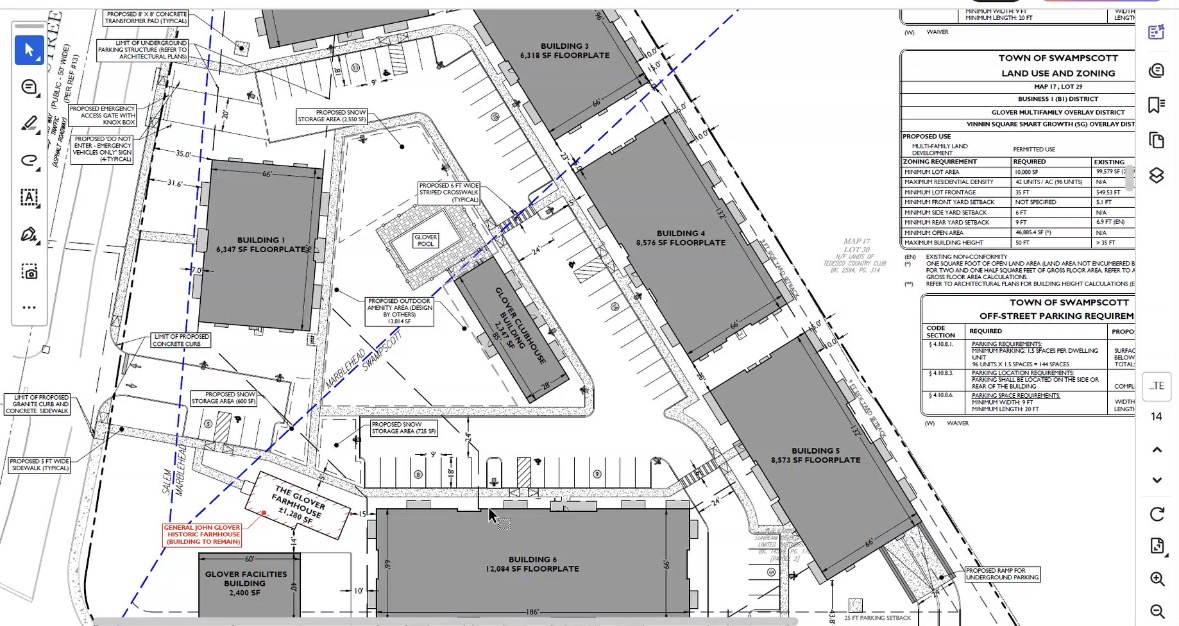
“We’ve been saying for a while that we’ve been expecting for the potential of our new growth to continue to increase in future years as projects like the Glover, the Hadley, Pine Street, all come online,” Hartmann said. “Those haven’t materialized yet, so they’re probably a few years out.”
Controlling the growth of real estate taxes, which Hartmann said is “really the biggest component of how we finance the town,” has been a focus for Swampscott “for many years.”
“We have some solid results to show for having been disciplined in budgeting and strive to lower the growth of the levy below what Proposition 2 1/2 would have allowed,” Hartmann said. “The town’s goal has not to have the lowest tax rate in the area, but we did find ourselves on the high end of many charts when we compared ourselves to other towns in Essex County or other peer communities that we have identified to be similar to Swampscott or even when we compare ourselves to Marblehead.”
Ten years ago, Swampscott had the fourth highest average single family tax bill out of the 34 communities in Essex County, at $8,961. In 2025, Swampscott is now the eleventh highest, with an average single family tax bill at $10,618.

When comparing with peer communities – which includes Georgetown, Hamilton, Hull, Ipswich, Lynnfield, Manchester-by-the-Sea, Marblehead, Middleton, Newburyport, Rockport, Scituate, and Winthrop – Swampscott has seen significantly slower tax-bill growth. Peer communities experienced 46% increases over the past decade, while Swampscott saw an increase of 19%.
“We have made significant progress while taking on significant projects to make Swampscott a better place,” Hartmann said.

Hartmann emphasized that assessed property values alone do not determine tax bills. The cost of operating the town is distributed across the entire tax base. Homeowners whose property values rise in line with the townwide increase will see comparable tax impacts, while those whose valuations change disproportionately may see different results. For the 2026 fiscal year, the median single-family assessment rose 2.3%, from $769,000 to $780,000.
These financial practices have helped Swampscott maintain its AAA bond rating from S&P Global Ratings.