Professional fundraiser Ronald Vigue was introduced Thursday at the Swampscott Historical Commission meeting as the head of partnerships for the new Save the Glover nonprofit.
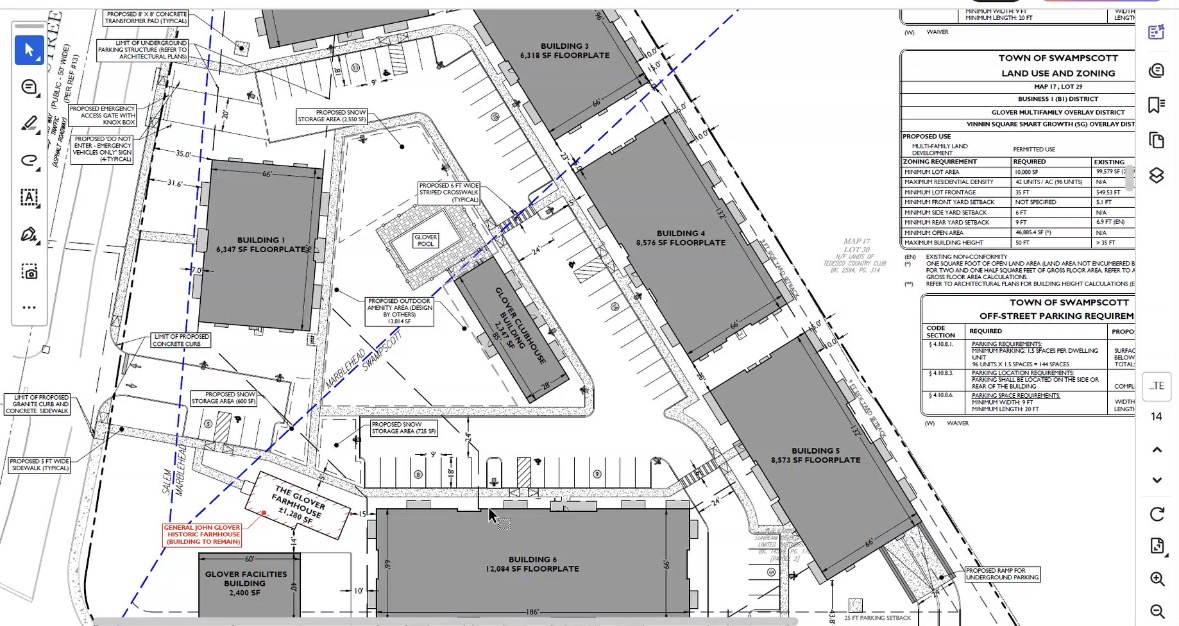
Efforts to save General John Glover’s farmhouse in Swampscott have now expanded to include a newly formed nonprofit foundation to support fundraising. Glover’s farmhouse may be the town’s only intact, original-era connection to the American Revolution. It is one of Swampscott’s oldest surviving homes and among the few remaining 18th-century structures in the region. The Historical Commission is working to raise between $1.5 million and $2 million to preserve the Glover Farmhouse and meet conditions proposed by National Development in its property plan.
“We have become legit over the last month or so,” Vigue said. “We’re saving the Glover, this very, very important building.”
Vigue currently serves as head of partnerships at PACT! The Power of Act. He was previously the head of fundraising at the Fondation KANPE Foundation and the director of development at the BRAIN Foundation. He was also the regional philanthropy officer for the American Red Cross of Massachusetts for three years, where he closed a $2.5 million gift from the New England Patriots foundation and its partners to help those affected by Hurricane Harvey.

“This is not my first rodeo,” Vigue said.
Vigue said he secured a $50,000 donation from a Swampscott resident over the past month. Historical Commission Chair Nancy Schultz added that the donor promised the same amount next year as well.
“That was pretty exciting,” Vigue said.
The nonprofit also received a letter of appreciation from filmmaker Ken Burns.
In 1775, Glover was elected lieutenant colonel of the 21st Massachusetts Regiment from Marblehead. After Colonel Jeremiah Lee’s death that April, Glover assumed command and led his troops to join the siege of Boston, where General George Washington chartered his schooner to raid British supply ships.
Known as “Glover’s Regiment,” the Marblehead militia became the 14th Continental Regiment, composed of about 500 local mariners and militiamen. The group famously saved Washington’s army from entrapment after the Battle of Long Island and later delayed British forces at the Battle of Pell’s Point.
Glover is perhaps most famously remembered for leading his regiment in rowing General Washington across the Delaware River on the night of December 25, 1776. The crossing culminated in a surprise attack on Hessian mercenaries in Trenton.
After the war, Glover was offered the chance to purchase the farmhouse property. Before the Revolution, it had belonged to Salem Loyalist and judge William Browne, whose land was seized by the Massachusetts government under wartime policies. Glover moved there in 1782, when the property encompassed 180 acres.
Over the years, the property was also owned by shoe manufacturer Alexander Little and Anthony Athanas, who opened the General Glover House restaurant with additions to the main house in 1957.
Today, the farmhouse sits on 1.56 acres in Marblehead, 2.28 acres in Swampscott, and about a quarter-acre in Salem. About 75% of the original house – including beehive ovens, doors, paneling and hardware – remains intact. Schultz said the property is eligible for both the National Register of Historic Places and National Landmark status.
Earlier this month, the house was named to Preservation Massachusetts’ list of most endangered historic resources. Properties were nominated by “concerned owners, community members, towns, and local organizations.” An anonymous review committee vetted the nominations and voted to select properties with “rich historical significance” in Massachusetts.
The Glover Farmhouse is the oldest building on this year’s Preservation Massachusetts list.
The group now has nine months to raise between $1.5 and $2 million to preserve the Glover Farmhouse, meeting the conditions proposed by National Development in its property plan.
“I don’t think that’s going to be a problem, candidly,” Vigue said. “It’s a local issue, but we are looking at folks nationwide and trying to get people involved. This is patriotic. This is a 250th anniversary thing.”
The Historical Commission also decided to “hit pause” on pursuing the creation of a single-housing district, which was thought of last meeting as a way to ensure the Glover Farmhouse would not be demolished. Schultz reported that National Development felt that the option would make them lose power over making decisions on the site.
“If we don’t have a good partnership and working relationship with the developer, there’s still a chance the building will be demolished in July,” Schultz said. “It might be best to put that on pause and really look into how we can develop a partnership.”
Schultz said National Development is willing to ensure the farmhouse is preserved if the nonprofit and commission take responsibility for restoring the exterior. National Development will go in front of the Planning Board in March, and “when they start their construction we can start our construction under the current scenario.”