Before his passing, Abe Piasek had a simple message: “Don’t hate.”
The adage came from a man who was almost always smiling, laughing and looking at the bright side of life. The message becomes even more profound when viewed in the context of Piasek’s life.
Piasek lived in Poland with his parents and sister when World War II began. During a time of systematic, state-sponsored persecution, Piasek and his family were among the millions of Jews who endured Nazi labor and death camps. Piasek was separated from his family, whom he never saw again, at age 13.
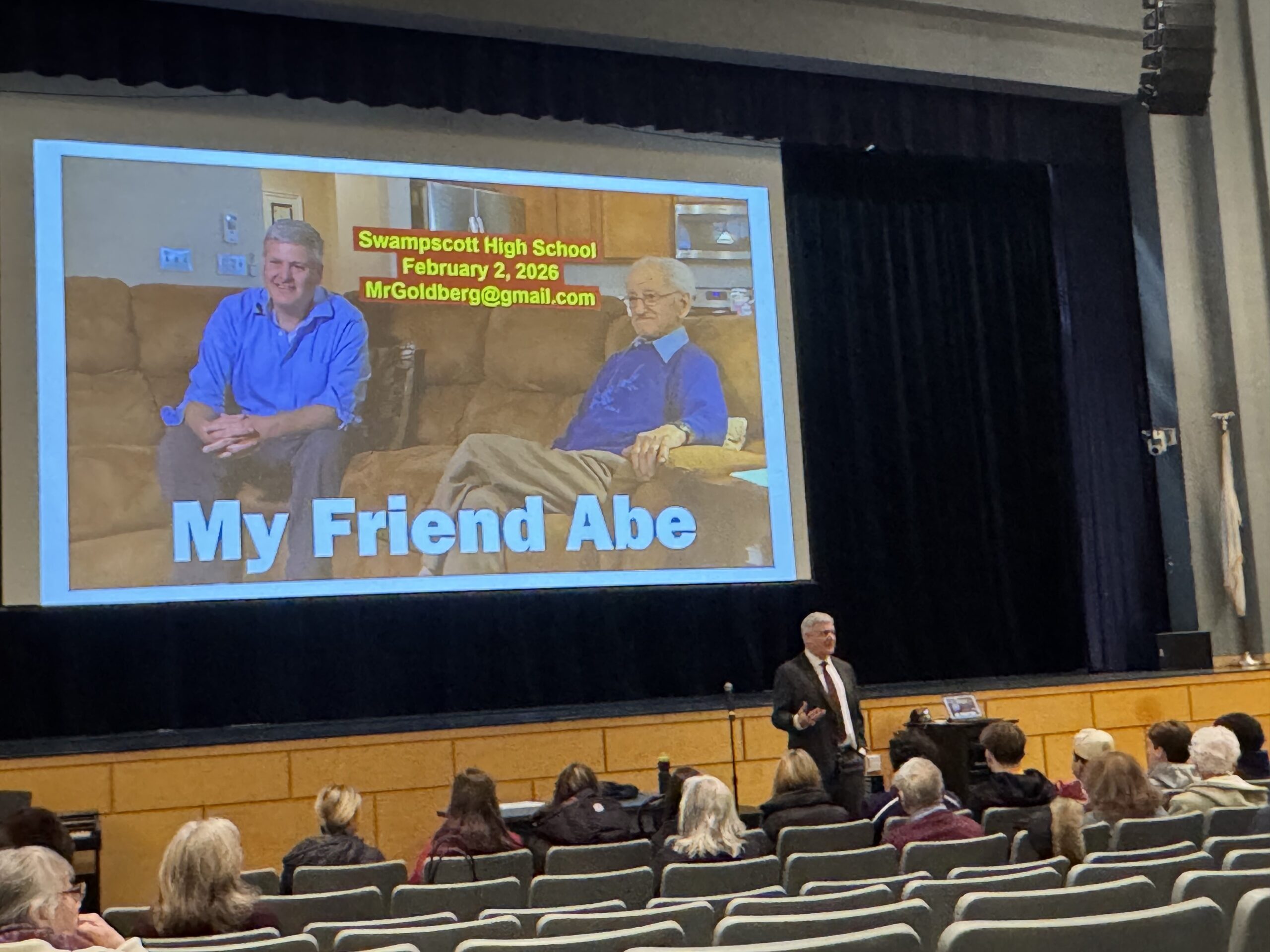
“He survived unimaginable horrors, and he remained – as you can see from these pictures – one of the most upbeat and inspirational people that I have ever met,” said Steve Goldberg.
A group of community members joined the Swampscott High School Anti-Defamation League (ADL) Club on Monday to hear Goldberg share the story of the Holocaust survivor.
Goldberg travels across the country sharing Piasek’s story. Swampscott’s audience was the 175th to hear the tale of Piasek, who worked in three slave labor camps in Poland and Germany until he was liberated at nearly 17 years old.
Just before Piasek turned 11, German forces invaded Poland. Two years later, he was forced onto cattle cars and taken to three different labor camps — Radom and Vaihingen in Poland, as well as Hessental in Germany. Weighing just 75 pounds, Piasek was liberated after almost four years when the cattle car he was in was bombed by Allied troops.
After World War II ended, Piasek spent two years in displaced persons camps in Germany. He later came to the United States, celebrating what he called his “personal Independence Day” every year on August 3.
Piasek did not share his story or speak publicly about his experiences during the Holocaust for 50 years. He lived in Connecticut, where he learned English, met his wife and owned Richard’s Bake Shop in Wethersfield before moving with his family to California.
After retiring to Florida, Piasek was interviewed by the Shoah Foundation in 1995, which sparked his interest in sharing his story with schools, synagogues and community centers.
“In the final decade of his life, he shared his story over 150 times,” Goldberg said.
When Piasek moved to North Carolina in 2009 to be closer to his family, he continued speaking to thousands of people, eventually earning the President’s Volunteer Service Award in 2005. Goldberg and his high school class were among the many people Piasek met with.
Following Piasek’s presentation, Goldberg first visited Piasek to learn more about his story, helping to chronologize the Holocaust survivor’s timeline. Goldberg also mentioned that his students were interested in visiting the Holocaust Museum in Washington, D.C.
“Abe perked up at that, and he said ‘Oh, I’ve never been. Maybe I’ll come with you,’” Goldberg said.
Piasek and his daughter joined the class of about a dozen students. Having never visited the Holocaust Museum before, Piasek wanted to see the cattle car.
“He wasn’t planning on seeing one when he went with us, but he had courage,” Goldberg said. “I can’t imagine the courage it took to do that.”
Piasek entered the space with the students, sharing his own liberation story – from a cattle car that was bombed outside of Dachau in 1945.
“I didn’t think I’d ever seat foot in a car,” Piasek told the students in a video Goldberg recorded. “My heart is pounding, and I had to show you.”
The last time Goldberg saw Piasek before his passing in 2020 at age 91, Piasek asked him to continue sharing his story with even more audiences.
“His story, I think, is a really powerful vehicle for thinking about the whole swath of the Holocaust,” Goldberg said.
Before sharing Piasek’s story, Goldberg also provided historical context about the Holocaust.
“Everything they did was legal, but just because it’s legal doesn’t mean it’s moral,” Goldberg said. “Slavery was legal. Discrimination in this country was legal. This was state-sponsored persecution and the murder of 6 million Jews and millions of others.”
Goldberg used the intergenerational audience as an opportunity to encourage discussion, allowing time for participants to interact and share their thoughts with one another and the larger forum. The group discussed the harm caused by bystanders and what it means to be an “upstander,” or someone who speaks out or acts against injustice.
For Piasek, “upstanders” were the people who ensured his survival, including a man who turned his back when Piasek stole a chicken and friends who lifted Piasek so he appeared taller and would be sent to work rather than to his death.
“If you see hate or discrimination, be an upstander, not a bystander,” Goldberg said to round out his presentation. “Take inspiration from Abe’s story and do something.”