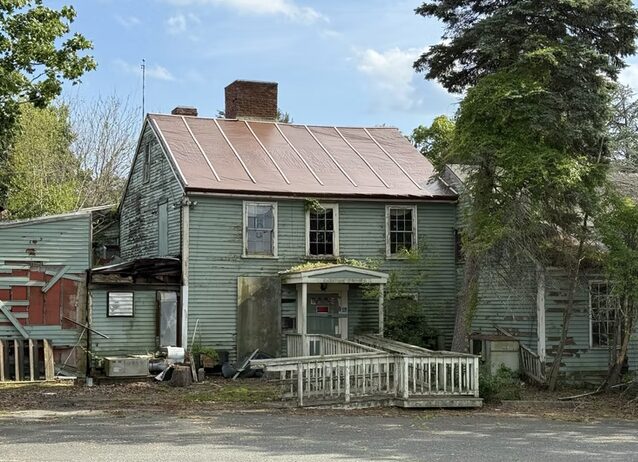
The efforts to preserve Gen. John Glover’s house has “received a major boost” after receiving an anonymous $50,000 gift from a Swampscott donor.
“This extraordinary gift reflects a deep commitment to preserving Swampscott’s history for future generations,” said Nancy Schultz, chair of the Swampscott Historical Commission. “We are profoundly grateful to this donor for recognizing the importance of protecting the General John Glover Farmhouse and helping ensure its legacy endures.”
Glover’s farmhouse may be Swampscott’s only original, still-intact direct connection that Swampscott has to the American Revolution. The building is one of the town’s oldest surviving homes and among the few remaining 18th-century structures in the region. With the anonymous donation, the nonprofit Save the Glover! has raised around $600,000 in donations and pledges toward its goal by the end of 2026.
“This gift brings us one step closer to securing the future of this irreplaceable historic treasure,” said Ed Nilsson, of the Marblehead Historical Commission. “Community support like this is essential to preserving the places that tell our shared story.”
Schultz previously estimated the exterior redevelopment will cost less than $1 million. However, the Historical Commission has recently been unable to fully assess the property because the owners, the Athanas family, have denied access.
A former estimate suggested $1.5 million would be enough for both the exterior and interior work. The additional money would be placed in an endowment, Schultz said.
Glover was a hero of the American Revolutionary War. In 1775, Glover was elected lieutenant colonel of the 21st Massachusetts Regiment from Marblehead. After Colonel Jeremiah Lee’s death that April, Glover assumed command and led his troops to join the siege of Boston, where General George Washington chartered his schooner to raid British supply ships.
Known as “Glover’s Regiment,” the Marblehead militia later became the 14th Continental Regiment, composed of about 500 local mariners and militiamen. The group famously saved Washington’s army from entrapment after the Battle of Long Island and later delayed British forces at the Battle of Pell’s Point.
Glover is perhaps most famously remembered for leading his regiment in rowing General Washington across the Delaware River on the night of December 25, 1776. The crossing culminated in a surprise attack on Hessian mercenaries in Trenton.
After the war, Glover was offered the opportunity to purchase the farmhouse property that Save the Glover! is now working to preserve. Before the Revolution, it had belonged to Salem Loyalist and judge William Browne, whose land was seized by the Massachusetts government under wartime policies. Browne would become Governor of Bermuda. Glover moved there in 1782, when the property encompassed 180 acres.
Save the Glover! efforts intensified after the town’s building commissioner notified the Historical Commission that the property owners had filed for a demolition permit in July. Although a nine-month demolition delay was previously placed on the development approved in 2022, that delay expired in January 2024.
The Historical Commission hosted a public hearing on the issue, hearing support to preserve the house from Glover’s descendants, Select Board members, an 8-year-old and other residents from the communities the Glover Farmhouse touches. Following, the Historical Commission voted to instate another demolition delay, which is set to expire July 20, coinciding with the nation’s 250th anniversary month.
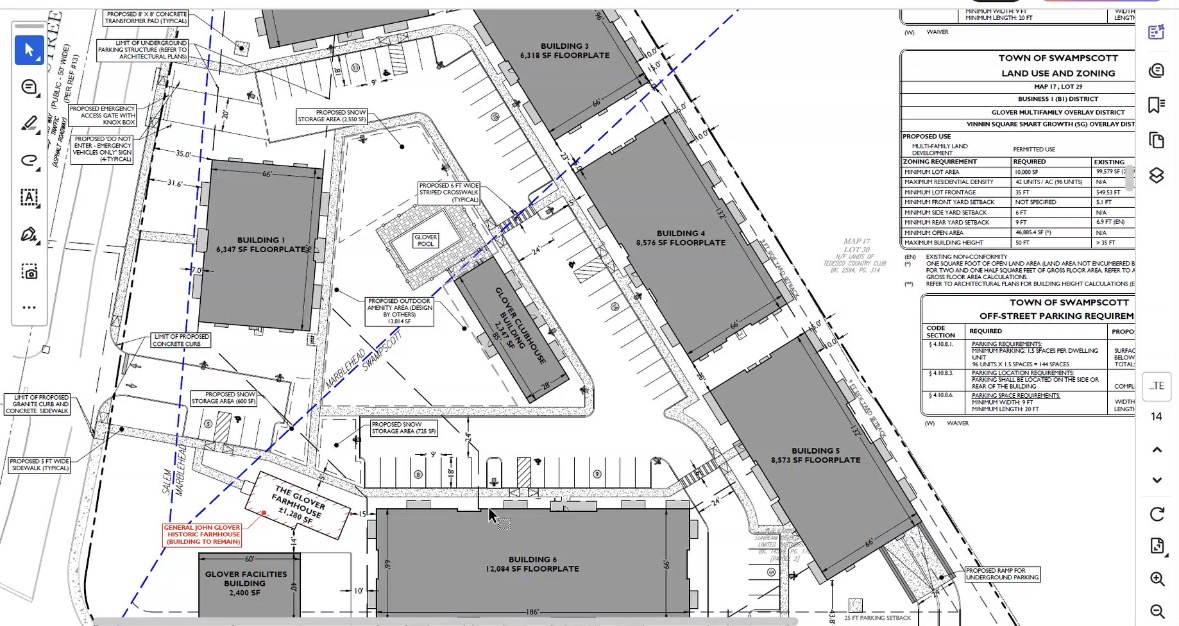
National Development presented a pre-application proposal for a multi-family residential project to the Planning Board in March. The plan confirmed the Glover Farmhouse’s continued existence.
Ryan Murphy, the vice president of development at National Development, said the overall design will align with standards in both Swampscott and Marblehead, as the farmhouse spans 1.56 acres in Marblehead, 2.28 acres in Swampscott and about a quarter acre in Salem. They will “lean into a New England aesthetic” with “a lot of vertical variation, a lot of horizontal variation” to encompass the look of a “downtown or a series of buildings that came together over time.”
To ensure the entire project is still able to accommodate the number of residents National Development was hoping for, the proposal showed three residential buildings, two four-stories plus the roof and a five-story building plus the roof. There will be a total of 140 units between all three buildings – 96 in Swampscott and 44 in Marblehead – with 220 parking spaces.
Planning Board Chair Ted Dooley expects the review of National Development’s proposal to take a few months. The board will need to decide if it accepts the developer’s push to exceed current building height variances by about 10 feet.
The Swampscott Select Board expressed its initial support, and push for a more clear business plan, in the preservation efforts for Glover’s farmhouse during a meeting on March 18.
Schultz told the Select Board the Historical Commission will remove “nonsignificant 20th century additions.” The Glover Farmhouse would be open to the public as a meeting place as well as retail and commercial opportunities.
The Historical Commission is targeting to begin exterior restoration to the Glover Farmhouse in July, “coinciding with the 250th anniversary of the birth of the United States of America.”
National Development, on the other hand, has said it will need 18 to 20 months to complete construction of its buildings. The anticipated grand opening will be in 2028, followed soon after – in 2032 – with the 300th anniversary of Glover’s birth.
To learn how to contribute to the preservation efforts, visit www.savetheglover.org.