By Charlie Jaferian
On the corner of the street by Vinnin Square in Swampscott stands a white farmhouse that could belong to any New England town. Its weathered clapboards and shaded windows blend into the neighborhood and offer little hint that the home office once belonged to one of the American Revolution’s most important military leaders.
This house was once the residence of Gen. John Glover, one of George Washington’s key commanders during the war. When Glover lived there in the late-18th century, the town wasn’t even called Swampscott.
“Many people, even Swampscott residents today, don’t realize that the town has ties to Revolutionary history,” said Nancy Shultz, chair of the Swampscott Historical Commission. “There is certainly Revolutionary War history here in Swampscott, especially when looking at the John Glover house.”
In 1781, John Glover purchased the property as a confiscated estate. After years of military service, including leading the Marblehead Regiment during the war, Glover spent time living in the farmhouse. At the time of his ownership, however, the land was not part of Swampscott. It belonged to an area historically known as the “Salem Finger,” which fell under the jurisdiction of present-day Salem.
Elsewhere in the town, reminders of the era still dot the landscape.
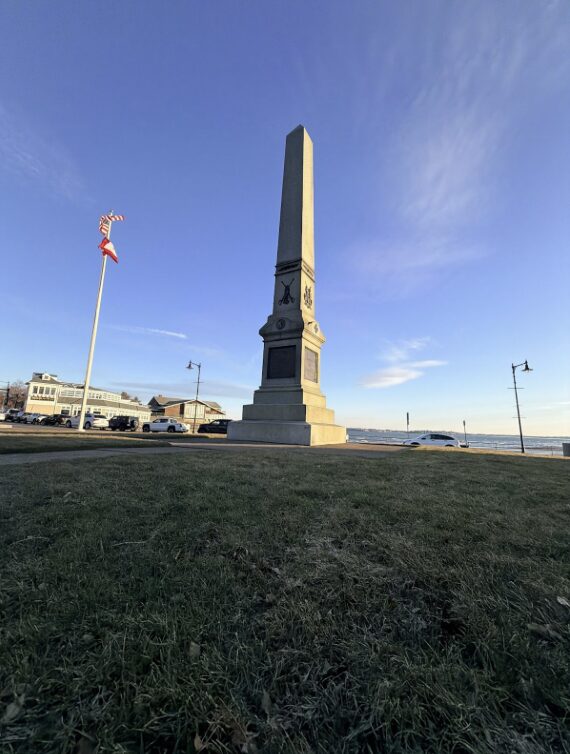
Along the coast, an Ingalls family monument stands on a small green, overlooking the road. The monument honors members of the Ingalls family who served not only in the Revolutionary War but also later in American conflicts. John Ingalls’ service in the Revolution established a legacy that would define the family’s place in town history. As the nation grew, so did the Ingalls family’s record of military involvement, with relatives serving in other key conflicts in our country’s history.
The monument represents more than a tribute to individual bravery. It reflects a long tradition of service and duty. In that way, the Ingalls story mirrors Swampscott’s, rooted in the Revolutionary era yet continuing to evolve generation by generation.
The history of these landmarks also appear in family stories.
According to descendants of the Ingalls family, multiple members living in what was then known as “Ingalls Row” left their homes in 1775 to march toward Lexington.
“By the time we get to 1775, when they’re going to Lexington, those Ingalls that are on that [row] are all descended from Edmund Ingalls,” John Ingalls said.
Five men from Swampscott are recorded as responding during the war’s early days, all tracing back to Edmund Ingalls, one of the earliest settlers of Lynn, who arrived in 1629.
The only remaining home from that cluster of houses that still stands today is the Swampscott Yacht Club, which was once the residence of Joseph Ingalls, who purchased it in the 1700s for a pair of cows before going on to serve in the war.
“I’m not sure if the average resident of Swampscott is really thinking about the past and how we almost stand on the shoulders of the people who came before,” John’s wife Rebecca Ingalls said.
For families whose ancestry stretches back 13 generations in Swampscott, the connection feels immediate and personal, the Ingalls said.
Charlie Jaferian is a student at Endicott College studying journalism. This story was published in partnership with the Massachusetts News Service.