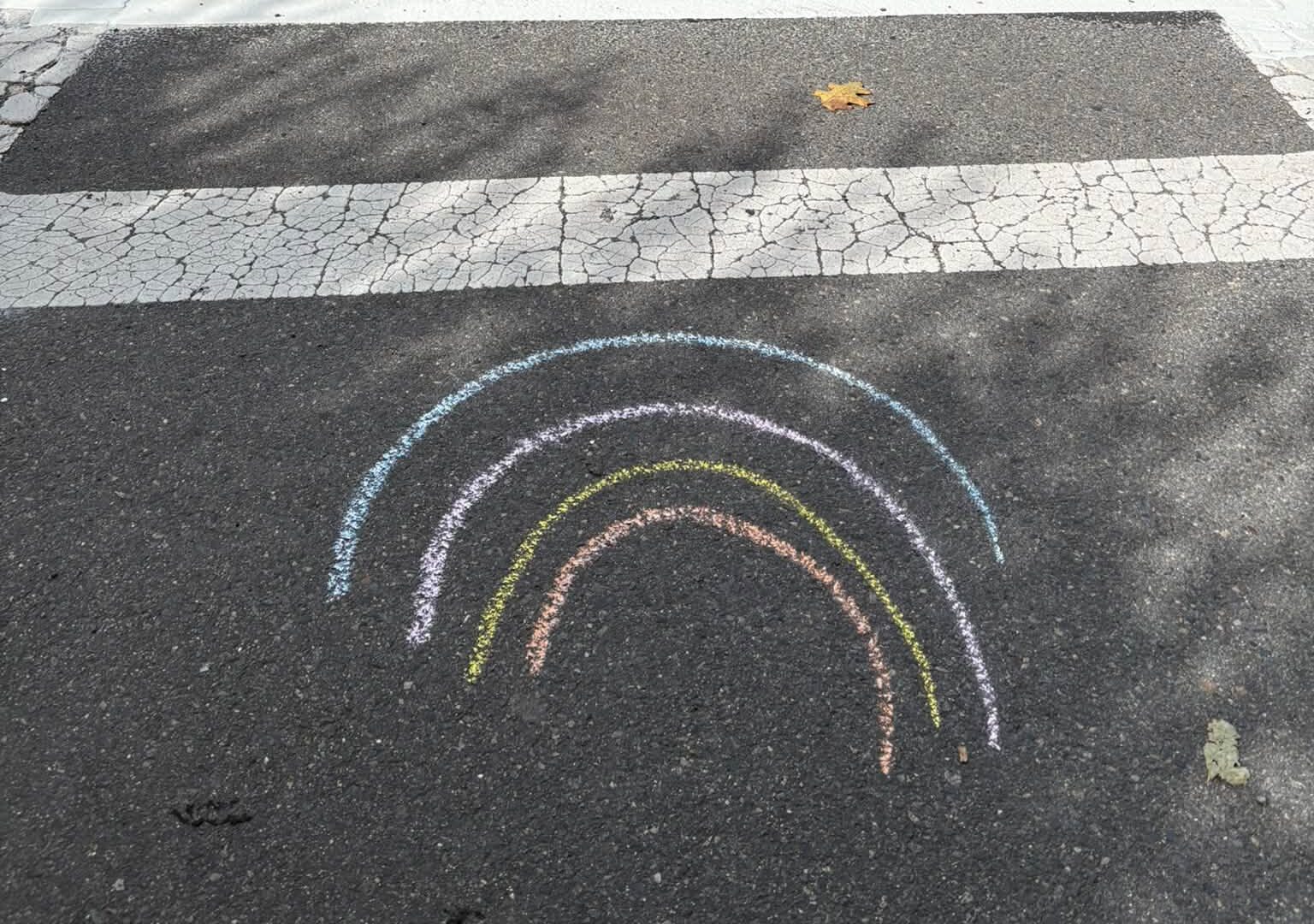
Residents have found their own ways to push back, drawing rainbows and launching a GoFundMe campaign after the town painted over the Pride crosswalk on Monument Avenue in black.
“I figured that someone should create a vehicle to help the donations come in and help defray the costs whatever those costs may be,” said Joe Strothman, who started a GoFundMe campaign to potentially restore the rainbow crosswalk.
On Friday, many residents were upset to find that the Pride crosswalks at Burrill Street and Monument Avenue had been repainted in the standard black and white. Swampscott’s Pride crosswalks were painted rainbow in June 2025, following a donation from Rebecca and Peter Spellios and support from the Select Board. The donation funded the repainting of 10 Pride crosswalks throughout town.

In a statement Friday, the town said the work was part of “routine maintenance” and did not reflect any change in its “unyielding commitment” to supporting and welcoming LGBTQIA+ residents, families and visitors.”
Peter Spellios told the Swampscott Tides on Friday that his family had not been notified of the change in advance. He did not respond to questions about whether he had an agreement with the town for how long the crosswalks would remain rainbow.
And now Strothman’s Go Fund Me has raised over $400, through 13 contributions, at the time of writing.
“If I can help promote the Go Fund Me, more money can come in and maybe we can do more crosswalks rather than less,” Strothman said. “It’s just people who like the crosswalk and want to support the town.”
Throughout town, another group of residents are also now marking other areas in town that “need routine maintenance” with chalk drawings of rainbows, as they also submit work requests at seeclickfix.com/swampscott/.


“I just thought that the way they went about blacking out the crosswalk and then citing routine maintenance when Town Hall wasn’t even open (on Friday) to hear the madness and then taking a full day to respond, it’s like ‘we’re telling you, we’re not letting you respond in any capacity,’” said Katie Arrington. “I wanted to find a way for residents who were feeling alienated to engage our town and say we’re not okay with this…Whether they meant the message or not, it’s saying something to our residents.”
Arrington and other residents have drawn rainbows near sidewalks in need of repair, crosswalks with peeling paint, potholes and other spots around town.
“It’s scary, and it’s taking our voices away,” Arrington said. “It generally concerns me of the direction that Swampscott is headed.”
In a Facebook post Monday, the town acknowledged residents’ concerns about the “recent restriping of select crosswalks has raised concerns among residents, and we understand the importance these markings hold for members of our community. “
“We remain unyielding in our commitment to ensuring Swampscott is a welcoming and inclusive community for all,” the post read. “The town is also reviewing the policies and procedures surrounding roadway markings, including those supported through private donations, to ensure there is a clear and consistent process moving forward.”
The town also encouraged residents to share their thoughts at the upcoming Select Board meeting on Wednesday, October 21.
“We appreciate the community’s engagement and will continue to approach this matter thoughtfully,” the post reads.
The history of Pride marches dates back to 1970, the one year anniversary of the Stonewall Uprising at a gay bar in Greenwich Village in New York City, according to the Library of Congress.
The first permanent rainbow crosswalks were in West Hollywood as part of the 2012 Pride Month celebrations, according to HuffPost. Similar crossings then popped up throughout the world the following year, in cities like Sydney, Australia and Tel Aviv, Israel.
Even as the colorful walkways have been widely adopted, they have been targets of defacement and vandalism. In 2011, the United States Federal Highway Administration suggested that “crosswalk art is actually contrary to the goal of increased safety and most likely could be a contributing factor to a false sense of security for both motorists and pedestrians.” Since, in the 11th edition of the US Manual on Uniform Traffic Control Devices, bright colored crosswalks are discouraged but no longer prohibited.
In May of 2025, Florida prohibited new installations of all aesthetic and non-standard crosswalk markings on the state highway system.
In Massachusetts, regulations distinguish between decorative pavement markings and those that function as traffic-control devices, which face stricter restrictions on permitted colors and uses.