Since the inception of Swampscott Unites, Respects and Embraces (S.U.R.E.) Diversity, its members have often been asked about the limited notion of what diversity means, with the conversation frequently focusing only on racial identity. In response, founding member Martha Curry created a world map for a S.U.R.E. Diversity event, inviting attendees to place a pin marking where their ancestors came from. Within a short time, more than 60 countries were represented.
Swampscott is a multicultural community with a rich tapestry of backgrounds and experiences. To highlight some of those stories, the Swampscott Tides has partnered with S.U.R.E. Diversity on its “Tell Us Your Story” project, inviting individuals to share where their ancestors came from, why they came, and what their heritage means to them.
These vignettes will be featured in the Swampscott Tides every other week and are also archived at the Swampscott Public Library.
If you would like to be included in the series, please send your 200-word story and photos to info@surediversity.org.
This week’s Tell Us Your Story is by Terri Bernhardt.
Throughout my life, when I’ve gotten questions about my heritage, I’ve generally had a stock answer, “Well, I’m a quarter Polish, a quarter Russian, a quarter French, and a quarter Spanish.” This reflects what I’ve always thought to be the ethnic backgrounds of my four grandparents. With the advent of 23 and Me, Ancestry.com, and the wealth of information now available on the Internet, however, I learned that most of these “identities” are really not accurate at all.
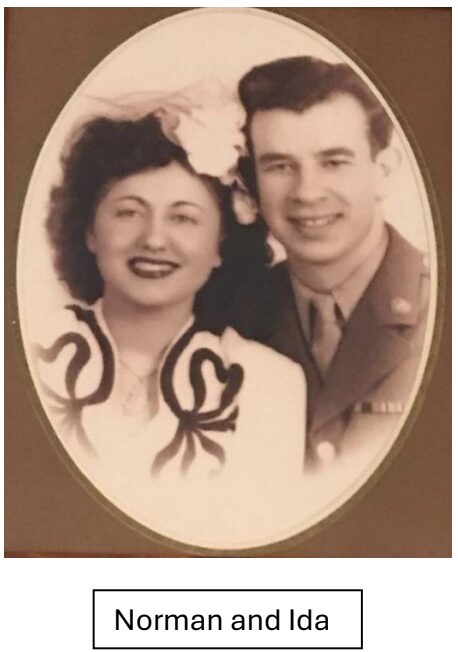
My paternal grandfather, Norman Machtinger, was born in Kielce, Poland in 1924. When he was 5 years old, he came to the U.S. with his mother and older brother. They met up with Norman’s father (Morris), who had come to Chicago many years earlier, probably to seek employment.
My grandfather not only had never met his father, but also knew no English whatsoever, and so was very scared when he and his brother arrived in the US and started school. They quickly adapted. He grew up in Chicago and later fought in WW2 and married my grandmother, Ida.
Because he was born in Poland, I naturally assumed that I have Polish heritage. But as a Polish Jew, he probably spoke Yiddish instead of Polish and lived with other Jews in their own separate enclave. At that time, Jews in Europe often moved from place to place, and so his family likely moved there from somewhere else entirely.
Grandma Ida was born in NYC in 1924. She grew up there within a large extended family that I had always heard was originally from Russia. In researching the family online, however, my brother discovered that they were more likely from Romania (which is consistent with my grandmother’s predisposition to use paprika as her only cooking spice). Perhaps the family started in Russia but then moved to Romania, or perhaps the opposite.
My maternal history is even cloudier. My mother’s mother (Ruth Simon) was born in Louisiana in 1914. My mom’s father (Joseph Trechel) was born in Louisiana in 1910. Most of their history is unavailable online and comes only from family lore. Rumor has it that Joseph had a gambling problem and won Ruth in a poker match! Ruth’s family spoke French, and so my mother always said that we were therefore of French heritage. This is true to an extent, but French-speakers in Louisiana are generally referred to as “Cajun French,”which is spoken across ethnic and racial lines.
In various Census documents, Ruth is referred to as “Negro,” “Mulatto,” or “Mixed Race,” though I only knew her as being “White.” Conversely, Joseph is generally listed as “White” though he had very, very dark skin in the summertime. My mother always said that he was Spanish, but family members wonder if he was actually Native American. There is little documentation on his background.
My 23 and Me profile tells me that I am actually a mélange of races and ethnicities. I am 49.1% Ashkenazi Jewish (from my father’s side), but otherwise am a little bit Iberian, British, Southern European, Sub-Saharan African, Native American, etc. What I have learned is that what we “are” ethnically is more of a representation of what we’re told we are, rather than a concrete truth.
Through this exercise, I’ve found that instead of creating a deeper connection to my ethnic and cultural roots, I’ve actually discovered even more of a divide. It matters little if I identify as Jewish, Polish, Russian, French, or Native American, because some or all of those ethnicities are likely to be false. What I’ve found more valuable is reading some of the stories my Grandpa Norman wrote me about his childhood, his in-laws, his love for his family.
I think it’s the people themselves who matter, not their racial backgrounds. My background is patchy and unclear. My children’s father, who was adopted, contributes an equally cloudy heritage. That leaves my children with an even bigger and unknown mix of pasts and histories. While this might leave some people aimless, without a “culture” to hold onto, I hope for my children it gives them the empowerment to build their own future, without biases and prejudices that might come from their pasts.