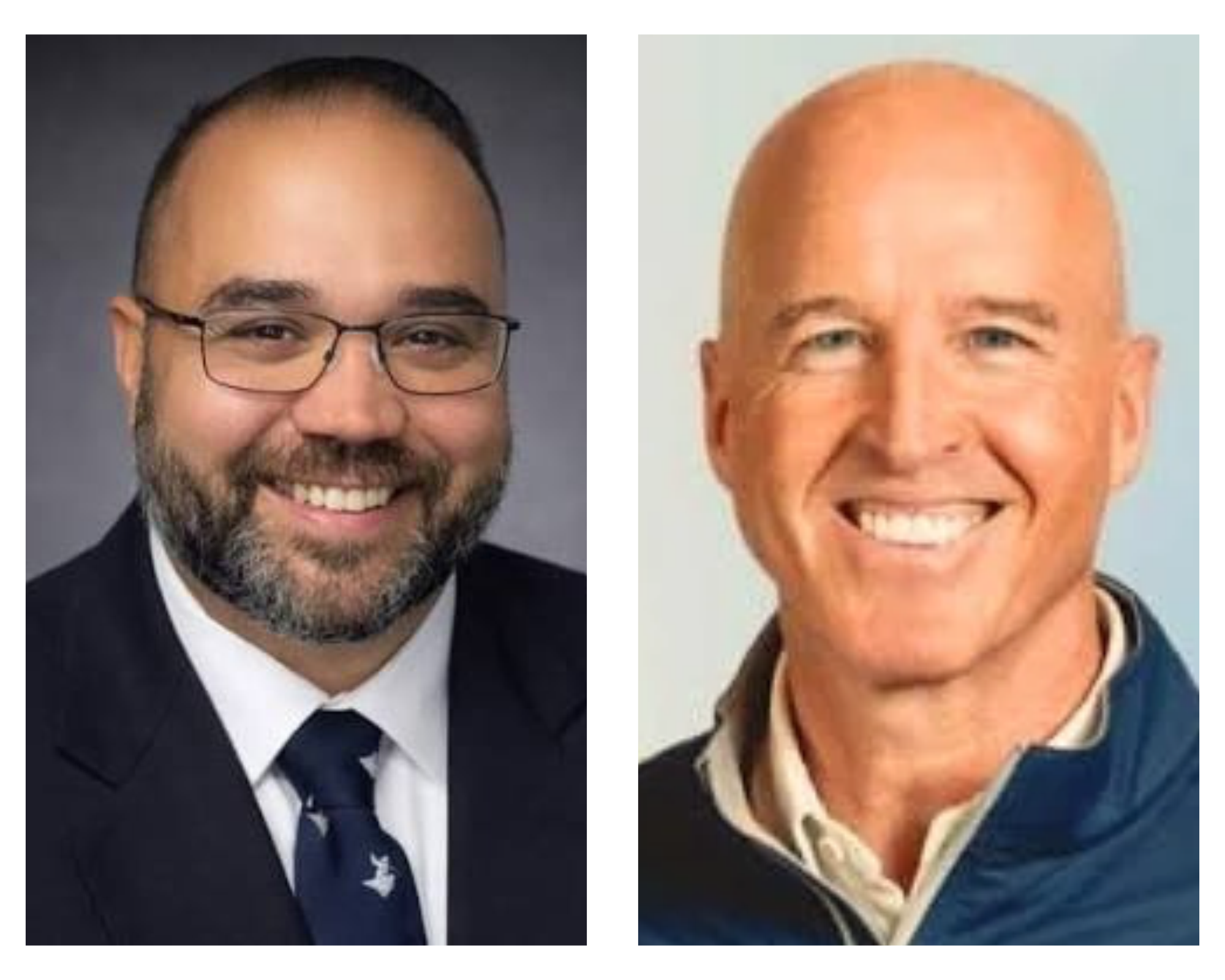
David Williams believes he’s a strong candidate for Swampscott’s next town administrator, citing that “I have a history of doing very well in tumultuous communities.”
One of three finalists for the Swampscott job, Williams was interviewed by the Select Board on August 12 at the high school. The 56-year-old applicant currently serves as human resources manager in North Smithfield, Rhode Island, and has previously served as town administrator in Sherborn and West Bath, Maine.
“Whether it’s board issues or communications with the public I’ve done very well in those communities to straighten things out,” Williams said.
Select Board Vice Chair Doug Thompson asked Williams to explain his description of Swampscott as “tumultuous.”
“As I look through the perception of watching meetings – and I have to go by the most recent meeting – there were continuous calls for improvement. There were things that the public implored the board to improve,” Williams said.
Williams likened Swampscott to Sherborn, where he was town administrator from February 2013 to January 2022, the longest tenure in recent memory. There, he dealt with several self-appointed citizens committees, including Save Our Sherborn (SOS), which opposed increases in the tax rate.
“We buckled down on the budget and made efficiency improvements,” Williams said. “They dropped the tax rate every year.”
By Williams’ fourth year as town administrator in Sherborn, the SOS committee had disbanded, he said.
“They gave a final presentation to the public and said they were happy with the town administrator addressing the tax rate,” Williams said. “I’m proud of that because the SOS committee was primarily made up of former select people.”
When asked if he was promising a decrease in the tax rate then in Swampscott, Williams chuckled.
“It takes time and attention,” he said. “And I’m very used to doing those things over the long term and the short term.”
Select Board Chair Katie Phelan asked Williams about the strengths and weaknesses of the board and how he might address internal conflict.
“I’m working for the board,” Williams said. “I can help with communication, take care of back-door meetings and help with transparency. Communication and transparency seem to be challenged among the board…The meeting I watched, in the public comments that came up four times, and that means something has to be done.”
A similar problem was addressed in Sherborn, by scheduling a weekly meeting with his top five department heads and allowing the public to attend, according to Williams.
“So the public would know when they could come in and talk with the department heads before getting riled up and going to the Select Board meeting and blindsiding everybody with an issue,” Williams said.
As Swampscott is set to negotiate contracts with the police department, fire department, library, Department of Public Works (DPW) and administrative assistants, Williams was asked about his collective bargaining strategy.
“As soon as I start, I’d like to talk with each of the presidents to see if there’s some sort of accommodation that could be made,” Williams said. “The strategy is understanding that it’s not a fight.”
He recalled negotiating with unions in Framingham, where he served from 2010 to 2013 as assistant town manager, HR director, and chief procurement officer. Williams independently supervised the departments of building services, media and technology, veteran services and human services. He was responsible for contracts, negotiating more than ten expired collective bargaining agreements.
“Over and over, I met with the unions and said ‘this is the condition of the town and here’s what our position is…This is how much we have on the table for the union…and if you want anything more than that you got to put something on the table,’” Williams said. “So the strategy is keeping open communication.”
Williams added that for the police department’s negotiations “I always have counsel by my side” because of the intricacies of the contract, ensuring the work is in the best interest of the town. He said the money for the counsel in this situation is well spent.
He also recalled “terminating” 75 bus drivers in Framingham when the city privatized its school busing services.
“They were picketing outside Town Hall, and you just have to try to be honest and open with them,” Williams said.
Most of the terminated drivers went to work for the private company contracted by the city, he said.
Even with negotiations and leading different departments, Williams noted that “in 25 years I have never appeared in court.”
“That includes 13 years as HR director,” he said. “Framingham had more than 2,000 employees. The probability is that you will do something wrong and be called into court, but I have been able to keep them out of court and not play out the strife in front of the public.”
He said he has been subpoenaed and responded to them, but that it’s really about “just knowing what’s going on and trying to prevent it.”
Select Board Member David Grishman asked Williams about developing service delivery partnerships with neighboring towns. Williams recalled an attempt in Sherborn to develop a regional maintenance contract that ultimately fell short.
“We put it out to bid and got a decent price, but it wasn’t any better than I could have got on my own,” he said. “In terms of consuming time it just wasn’t worth it.”
Another collaborative effort in Sherborn – the prospect of sharing a sustainability coordinator with neighboring town Holliston – ended because the two municipalities had different visions for funding that was earmarked by the state legislature. Sherborn ended up creating its own sustainability office.
“Watching how that moved up through the other town was a learning process because boards function in so many different ways,” Williams said. “Some give leeway, and some don’t…When you go to do something you need to know the players involved and what their back issues are. You can’t operate in a vacuum or alone, you have to know what’s going on.”