The Swampscott Historical Commission has researched properties in the town’s Railroad neighborhood in an effort to preserve historic areas and encourage homeowners to apply for historic house plaques.
The Commission works to identify, protect, and preserve Swampscott’s historic resources and heritage by documenting buildings and properties that are part of the town’s historical narrative and fabric. Over the past year, the Commission used a portion of its 2024–25 budget to document a section of the Railroad neighborhood, which Commission Member Kim Barry described as “an important 19th-century area that is understudied in the town’s history.”
Funding from the Commission’s budget was used to research 15 properties and to file the resulting reports with the Massachusetts Cultural Resource Information System (MACRIS), which is managed by the Massachusetts Historical Commission (MHC).
Property research included deeds, atlases, and census records. The findings were compiled into Form B reports and submitted to the MHC. The properties are now officially inventoried in the MACRIS database.
The project began in 2023 following the demolition of 35 Pitman Road, which research showed dated back to the late 18th century, according to Barry.
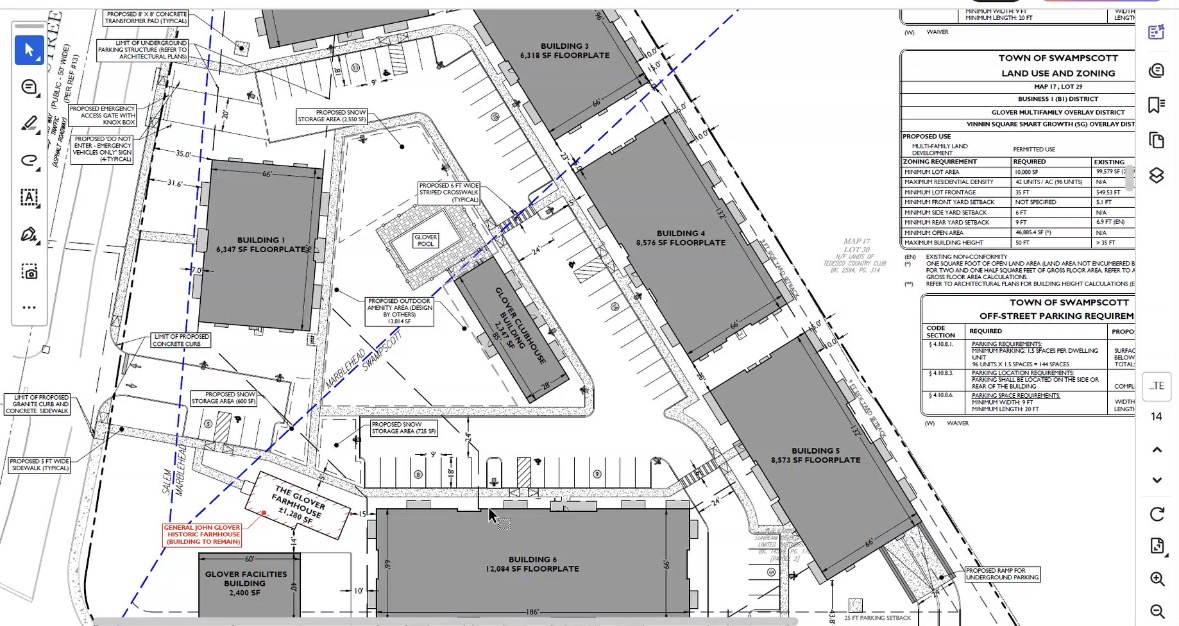
Known as the Pitman House, the building was demolished in 2023 to make way for what is now the Westcott. The house was once home to town founder Samuel Cloon Pitman and Revolutionary War hero Joseph Richards.
The Swampscott Historical Commission identified the property as one of only a “handful of similar period homes known to be left standing” at the time of the research. The house also predated Swampscott’s incorporation in 1852.
“When the town lost the Pitman farmhouse, it prompted the commission to explore the area around the train depot further,” Barry wrote.
An 1856 atlas of Swampscott showed a concentration of buildings stretching from the train depot along Burrill Street to Humphrey Street and toward the Blaney Beach area.
“It was apparent that with the arrival of the Boston and Maine Railroad, the population of Swampscott and number of buildings grew, connecting the railroad to the coastline,” Barry wrote.
Using public record build dates, the commission identified properties beginning at Burrill Street near the Civic Center and continuing along Burrill Street, Rock Avenue, Boynton Street, Pine Street, Railroad Avenue, and areas around Essex Street.
The original list included more than 100 properties but was narrowed to 24, focusing on the oldest recorded build dates. Due to budget limitations, the list was ultimately reduced to 15 properties.
Several of the properties shared a common architectural feature: double Gothic-style gables, according to Barry. Homes such as 8 and 11 Boynton Street — both demolished in October 2024 — featured the style, which includes two steeply pitched triangular roof sections, often accented with pointed arches and decorative elements.
The Swampscott Historical Commission had voted in January of 2024 to impose a nine-month demolition delay in hopes of preserving the two Boynton Street properties.
The commission recently mailed the reports to each of the respective homeowners, “telling the interesting story of their property history,” Barry wrote.
Homeowners are now invited to apply for a historic house plaque through the commission’s historic house research and plaque program. The program helps fund preservation-minded projects, including property inventories.
Each year, the commission offers residents the opportunity to request a research report and plaque for a commission-negotiated fee with its vendors. Applications are available on the town website through the Swampscott Historical Commission’s pages.
For further information on the Railroad Neighborhood research effort or the Commission’s Historic Plaque Program, contact Commission Member Justina Oliver at shc@swampscottma.gov.