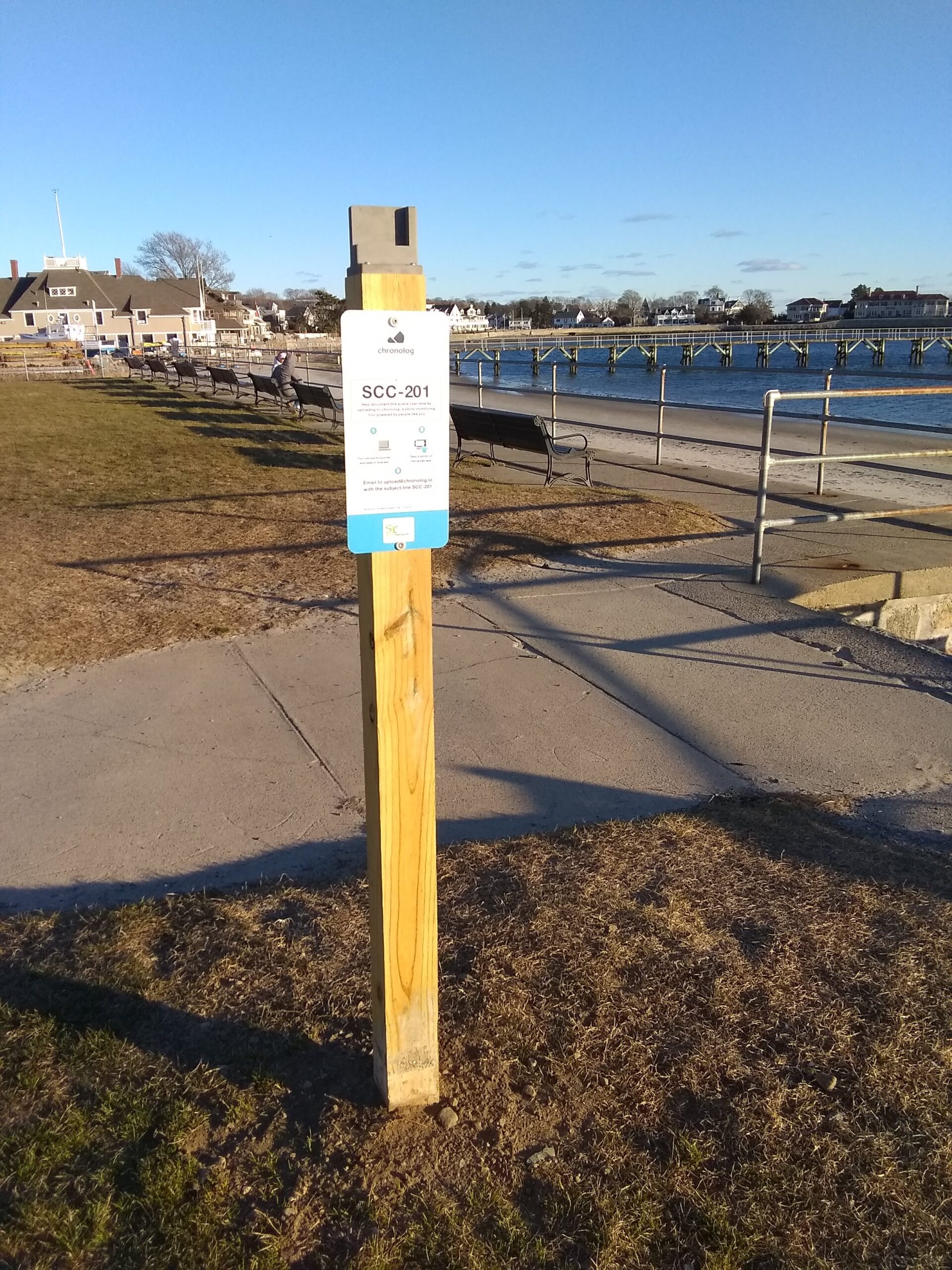
The Swampscott Conservancy, in collaboration with the town, has installed a Chronolog station at Chaisson Park at Fisherman’s Beach, allowing North Shore residents to become citizen scientists.
A Chronolog is an easy-to-use, worldwide citizen-science monitoring tool that creates time-lapse imagery from photos submitted by the public, according to Colleen Hitchcock, a conservancy member and Brandeis University professor. Chronolog is used by organizations to monitor environmental changes and inspire stewardship. Stations are located around the world, including Shenandoah National Park in Virginia, Tygerberg Nature Reserve in Cape Town, South Africa, Squam Lakes in New Hampshire and Kagen Klitplantage in Denmark.
“To use it, passersby simply place their iPhones in the pre-installed bracket, take a photo and then email it to the address posted on the Chronolog station,” Hitchcock said. “There is no need to download an app or create an account to participate.”
The photos are compiled into a time-lapse sequence showing changes to the area over time. The photo time lapses are available on the Chronolog website.
In Swampscott, images captured at Chaisson Park will document changes over time at Fisherman’s Beach, the pier and the Swampscott Fish House.
“As more and more photos are added, we’ll be able to view how the shoreline at Fisherman’s Beach is impacted both by the strong storm surges we’ve been experiencing and those seasonal ‘wicked’ high tides, called ‘King’ tides,” Hitchcock said.
During the “King” tides and certain storm events, high tide at Fisherman’s Beach can be two to four feet higher than normal. The pier can often become submerged, and flooding can extend past the traffic light at the intersection of Puritan Road and Humphrey Street, where the Fish House is located.
“These high tides provide us with a window into how sea level rise will soon start affecting our daily lives,” Hitchcock said. “As Swampscott plans for the impacts of climate change, the photos submitted by the public will help the town in formulating responses.”