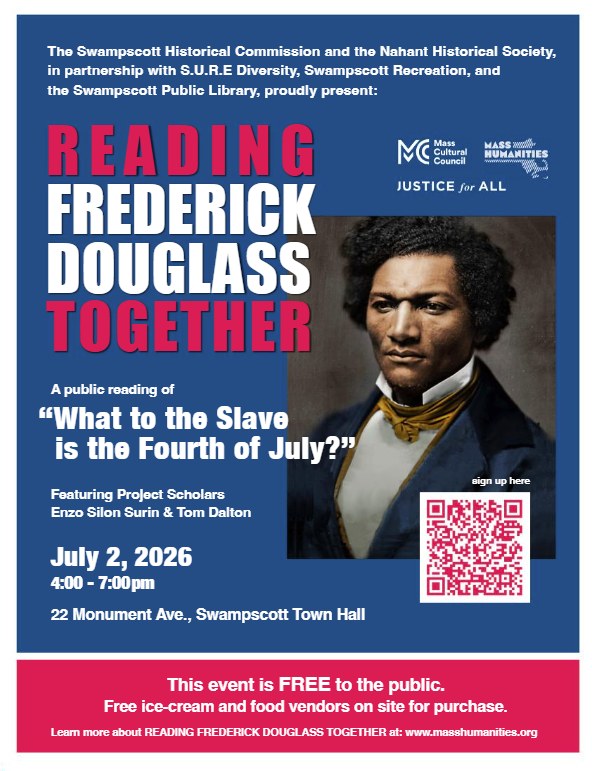
The town will gather on July 2 for the second annual reading of Frederick Douglass’ “What to the Slave is the Fourth of July?”
The free event is sponsored by the towns of Swampscott and Nahant, along with Swampscott Unites Respects Embraces (S.U.R.E.) Diversity and the Swampscott Recreation Department, through a grant from Mass Humanities and the Mass Cultural Council. The event is meant to help people connect Douglass’ legacy with their community and American values.
“It’s an amazing experience of a prescient oration by one of the most articulate, persuasive statesmen in American history,” said Ralph Edwards, the project director.
Douglass was an abolitionist, orator, writer and statesman. After escaping slavery in 1838,Douglass became a nationally known abolitionist leader in Massachusetts and New York and was a member of the Massachusetts Anti-Slavery Society.
“Some historians refer to him and other people of that era as the second founding fathers,” Edwards said. “They were wrestling with what to do about slavery.”
Douglass lived in Lynn while giving some of his most famous speeches, but Historical Commission Chair Nancy Schultz noted that it’s especially important with the “collaboration between Swampscott and Nahant, that we were part of Lynn until 1852, 1853.”
“Beyond Frederick Douglass being our neighbor, he was, in fact, our townsman,” Schultz said. “We were all part of the same town. That really made an impression on me when I started to think about it…Just to be close to history like that is amazing.”
Edwards said it is important for the community — especially students — to learn about Douglass.
“I think he can inspire them, that regular people, in so many ways, can do extraordinary things,” Edwards said.
Schultz spoke of how Douglass was born to “ordinary circumstances for the age” but that he rose to meet the challenges and requirements of his day.
“Frederick Douglass was obviously remarkably brilliant, taught himself to read and developed himself under very difficult circumstances…People were surprised. People said ‘How can a Black person be so elegant, speak with such grace?’,” Schultz said. “He rose to meet what was needed in the times he lived…We’re all ordinary people going to this event, but any one of us in the moment, if we rise to meet the historical moment, we can all have the chance to rise to greatness.”
In his Fourth of July Speech, Douglass commented on the hypocrisy of the American celebration of freedom while slavery still existed, and criticized the gap between American values of liberty and Black oppression.
“He’s challenging his audience, who were mostly abolitionists, on their respect for the humanity of Black people because for many of them, they were against slavery but they did not necessarily acknowledge the humanity of enslaved people,” Edwards said. “They, as well as the president, would agree to free enslaved people but send them to Africa. Douglass is saying no. They’re human beings with human rights and every right to be here.”
The speech is divided into 60 sections, and S.U.R.E. Diversity is encouraging participants to read in teams this year to allow for broader participation. There will be a discussion following the reading as well.
Edwards and Schultz also emphasized that this year’s event coincides with the nation’s 250th anniversary.
“When Douglass gave this speech, the country was at a crossroads because this is pre-Civil War. There’s great division in the country,” Edwards said. “Douglass lived through the emancipation and then the reconstruction where Black men who weren’t allowed to vote were elected to local office. He also lived through the end of reconstruction where all that was taken away. And we are going through a period now where because of the civil rights movement we’ve had Black and other folks of color elected to high office or a Black president, but now with the voting rights erosion that’s being taken away.”
But Edwards said people “have to maintain hope, and we have to act to assure that the Constitution is respected and followed.”
The event will run from 4 to 7 p.m. on July 2, with free ice cream as well as food vendors on site for purchase. The Lynn Museum has also donated passes for attendees to visit its exhibit on Douglass, Edwards said.
To sign up to read, visit https://www.signupgenius.com/go/10C044CA9AD28ABFFC34-64088572-frederick#/.