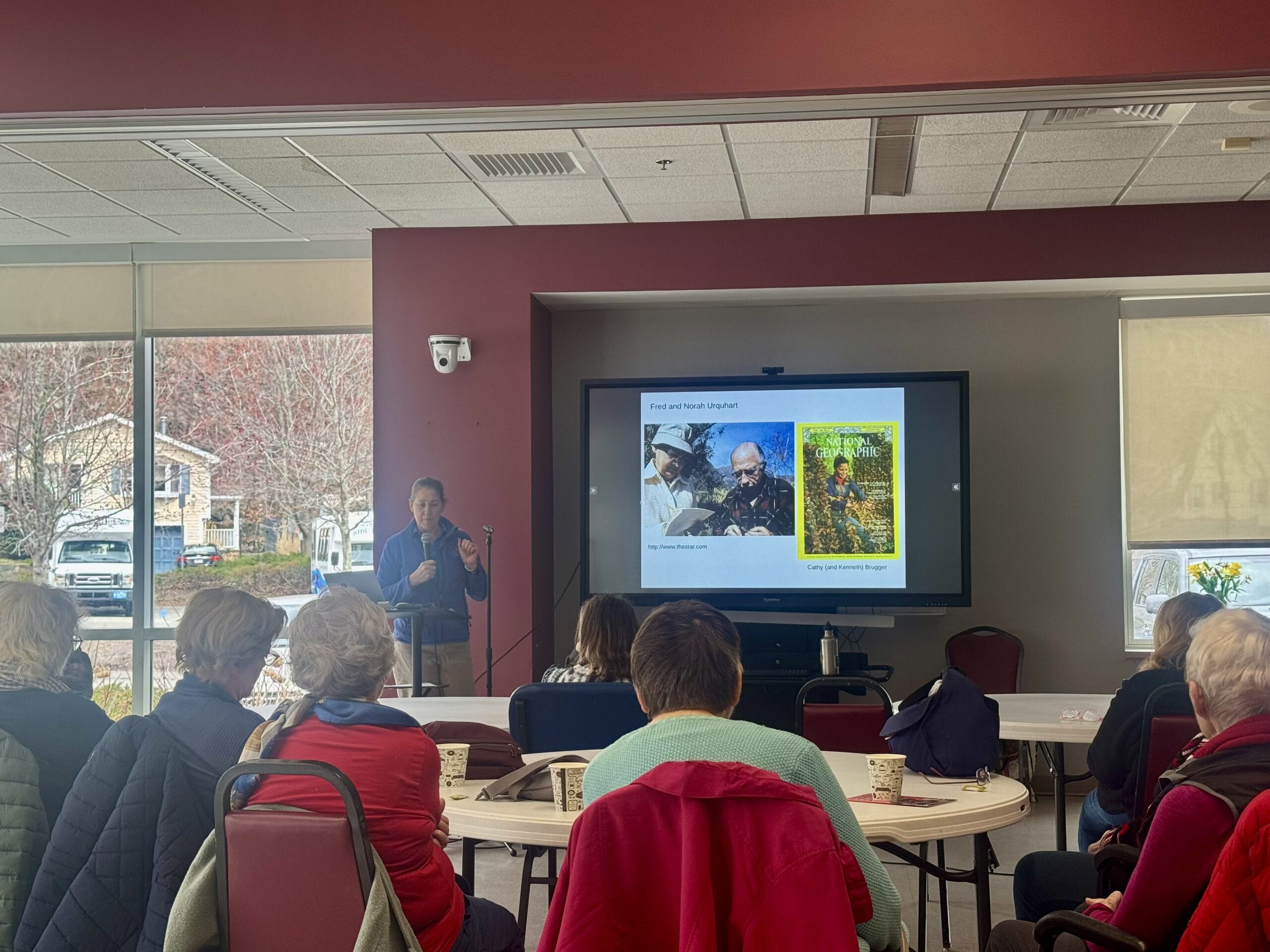
The migration patterns of the eastern North American monarch butterflies were not discovered until January 1975.
Researchers Kenneth Brugger and Catalina Trail worked with Fred and Norah Urquhart to locate the orange and black insects’ overwintering sites. The butterflies migrate 3,000 miles to specific high-altitude forests in central Mexico, following years of citizen science tagging led by the Urquharts to map their paths.
“To this day you have to ride a donkey up the mountain. It’s very steep. Then you have to walk the last bit because it’s so steep even for donkeys,” Katie Banks Hone said in a talk at the Senior Center. “But he gets up into the reserves and he sees millions and millions of monarchs up in the trees. He sat down to catch his breath and one of these branches was so heavy with the monarchs on it, it actually broke and it fell to his feet. He looked down, and there was a monarch with one of his tags.”
Gardener and scientist Banks Hone gave a presentation Monday at the Senior Center on monarch butterflies and how to create yards that attract them. About 20 residents attended to learn about migration patterns and conservation efforts.
Banks Honor has been helping local landowners transform their properties into havens for wildlife since 2014. She is a recipient of the U.S. Fish and Wildlife Service’s Slow the Flow grant, which helped her transform her own property by the Ipswich River.
Banks Honor runs a small native plant nursery and farm stand but also shares her knowledge in lectures and classes, like at the Swampscott Senior Center. She told the seniors in the audience that they too can plant flowers that will attract – and help enhance the population of – the monarch butterflies.
She spoke of blazing star – or liatris – Joe Pye weed, salvia, sedum, aster, zinnias and Mexican sunflowers. While the butterfly bush is attractive to the monarchs, they are almost like a piece of candy.
“It’s like if I give my teenagers Skittles or jellybeans,” Banks Honor said, “versus giving them a protein ball made with peanut butter and nuts and something that’s going to sustain their energy so they can study for their AP exams. They’re going to eat the jellybeans and their chocolate and have a sugar crash and not be able to study. That is the butterfly bush, low protein, high sugar, empty calories.”
Monarchs need these “waystations” though for the necessary resources to produce more generations and sustain their migrations. According to Monarch Watch, there are 55,096 waystations throughout North America.
This is especially important as monarch populations have steadily declined over the years.
“The population peaked in 1997,” Banks Home said. “That was one billion monarchs, and it steadily decreased.”
This year, Monarch Watch is estimating there are 2.93 hectares of monarchs, measured by the space they take up while in Mexico.
The monarch butterfly typically hits Texas in its path back to the East by April, making it to the New England states around June. They look for one specific plant, the milkweed, because it’s “the only plant monarch caterpillars can eat.”
“They go back to the same places,” Banks Honor said. “This what got me really fascinated as a scientist with monarchs. I had my GPS off the entire way here, from about Salem State South because I knew from about Salem State South there were a couple little turns, and I wasn’t going to find it. I’m not familiar with Swampscott. But these monarchs, they get from way up here all the way to Mexico with no GPS.”
Remarkably, the monarchs migrating to Mexico have never made the journey before. They were born in New England. Most of the previous generation that migrated north from Mexico die along the route, often in Texas.
“There’s still science to be discovered,” Banks Honor said. “It’s pretty amazing.”