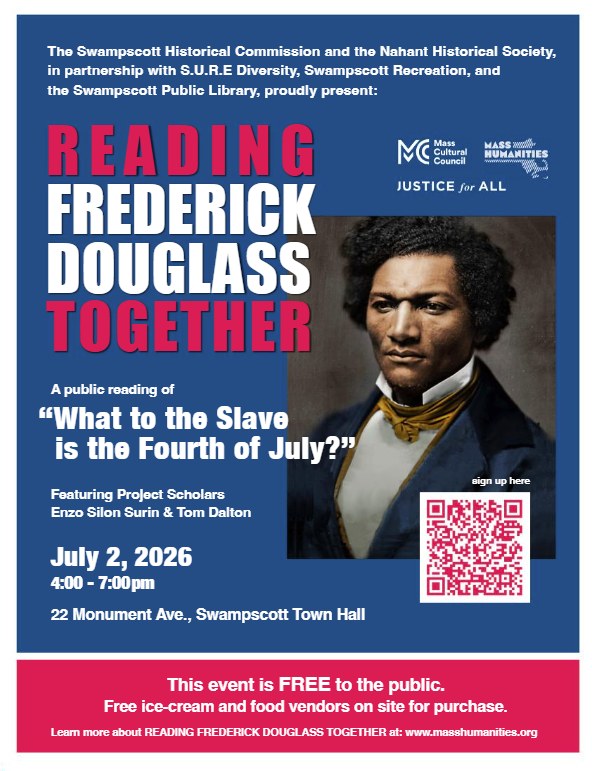
Following Swampscott’s annual reading of Frederick Douglass’ “What to the Slave Is the Fourth of July?,” poet and social advocate Enzo Silon Surin will lead a panel discussion on the speech’s impact in both 1852 and today.
The free event on July 2 is sponsored by the towns of Swampscott and Nahant, along with Swampscott Unites Respects Embraces (S.U.R.E.) Diversity and the Swampscott Recreation Department, through a grant from Mass Humanities and the Mass Cultural Council. The event aims to help residents connect Douglass’ legacy to their community and to the nation’s founding ideals.
Douglass was an abolitionist, writer and orator. He was one of the most prominent figures in the 19th-century African American civil rights movement. Surin is a Haitian-born poet, educator and advocate who creates space for reflection and belonging.
“Douglass refused to separate the American promise from the American reality and in many ways the American identity that was fragmented at the time,” Surin said. “It’s a way to bring the community together and have a conversation that we may not have otherwise.”
Douglass arrived in Lynn – which Swampscott was a part of at the time – at age 23 in 1841 and lived there for six years, during which he wrote “The Narrative Life of Frederick Douglass.” Because some doubted he had ever been enslaved — citing his manners and his abilities as a reader, writer and orator — Douglass wrote the autobiography that would become one of the most influential slave narratives in American history.
A few years after leaving Lynn, Douglass delivered his famous Fourth of July speech, condemning the hypocrisy of celebrating freedom while slavery persisted and highlighting the gap between America’s ideals of liberty and the oppression of Black people.
““I think part of why this matters is we’re about to celebrate this country’s 250th anniversary and I started to think about what does July 4 mean to us now,” he said. “Is it something that’s celebratory in terms of ceremony or is it simply that we continue to identify the main principles that lead to the freedom of this country? I think that is embedded in the speech that he gave in the time that he gave it. I want people to have a way to say what does that mean now.”
Surin’s will host a panel to continue the conversation around Douglass’ speech. Questions will be posed to the audience, and Surin will facilitate a discussion about what the speech means to participants while creating space for reflection, differing perspectives and difficult conversations.
“The whole idea is that Frederick Douglass’ speech is not simply a historical artifact. It’s a living conversation that we’re still having,” Surin said. “I wanted to make sure that there was a way for people to still have that conversation and continue it.”
Surin said he hopes the panel will encourage reflection long after attendees leave the Town Hall Lawn. He also pointed to the fact that the country has “seen a lot of shifts” in recent history.
“We’re starting to see a lot of civil liberties getting threatened and a lot of people not sure what to do with that,” Surin said. “This is a great way to remind them of their civic responsibilities and that community gathering is a part of civic engagement.”
Surin did note that there’s sometimes the feeling of “a level of judgement” around these topics but that “we live in the same communities.” Rather than being about Democrat versus Republican, Surin said the conversation is around the ideals and principles people live by and share.
While Swampscott may not be among the region’s most racially diverse communities, Surin said events like this benefit from a diversity of perspectives and experiences.
“It’s a way to address certain things that we may not be aware of that each person is going through,” Surin said. “People identify with different political ideologies, and I think that we see more of a division in our communities because of that. It’s polarizing in many ways, and I think that the tension comes from having conversations with people, confronting truths that we may not always have time to confront. I don’t think it’s adversarial in any way…It’s a discomfort to share. This is a way to allow for conversation and for us to listen to each other.”
The event will run from 4 to 7 p.m. on July 2, with free ice cream as well as food vendors on site for purchase. The Lynn Museum has also donated passes for attendees to visit its exhibit on Douglass.
The speech is divided into 60 sections, and S.U.R.E. Diversity is encouraging participants to read in teams this year to allow for broader participation. There will be a discussion following the reading as well.
To sign up to read, visit https://www.signupgenius.com/go/10C044CA9AD28ABFFC34-64088572-frederick#/.