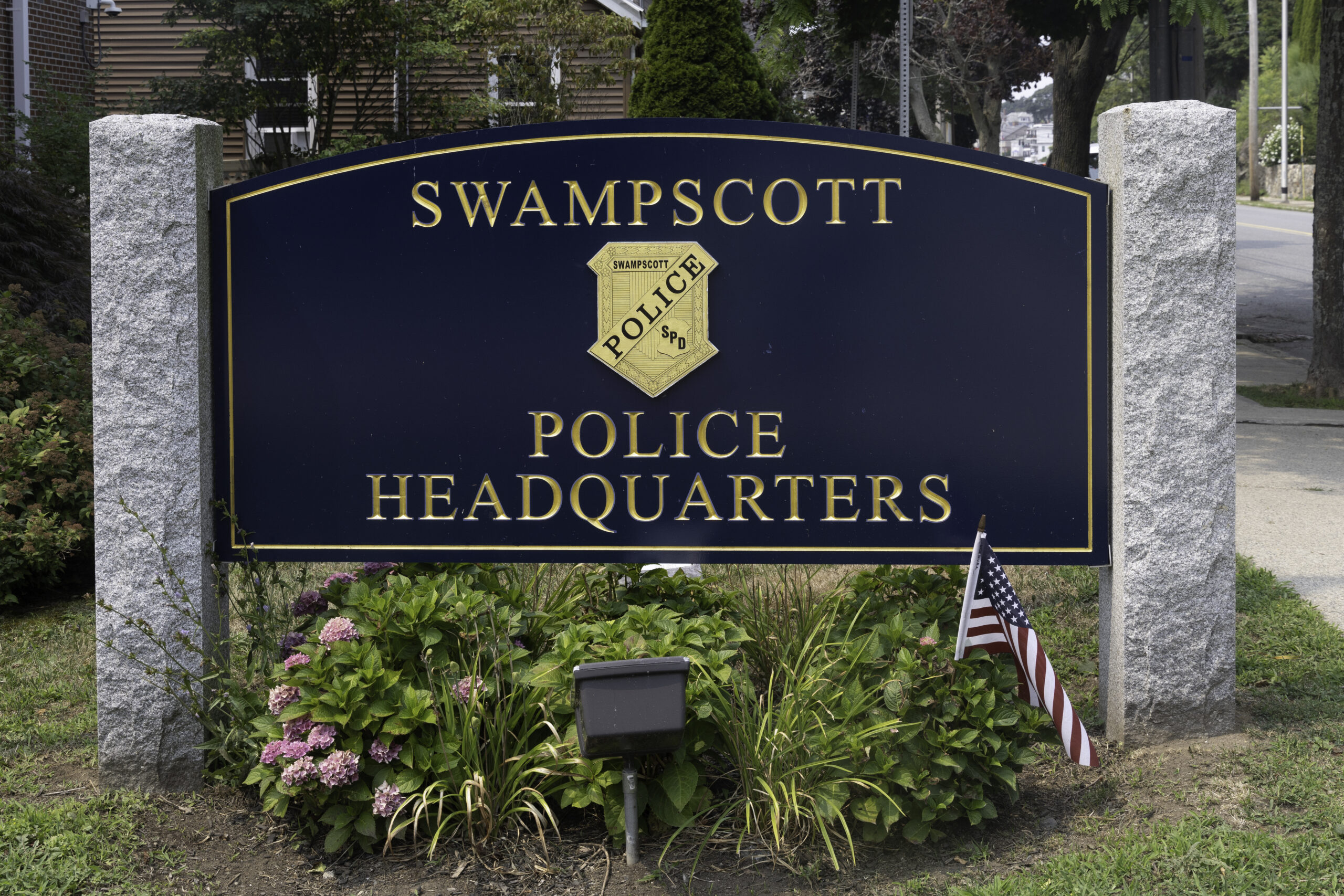
As a Swampscott police officer remains on administrative leave amid an investigation into potential misuse of Lynn’s Flock license-plate reader system, it has become clear that the Swampscott Police Department does not have guidelines specifically governing the use of Flock Safety technology.
The Swampscott Tides reviewed department documents showing that Swampscott does not have a Flock Safety-specific automated license plate recognition (ALPR) policy. The department’s existing policy, established in 2015 and reviewed in 2023, was written for its own ALPR system, which officials say has been out of service for approximately five years. Yet the department said after the investigation began that authorized personnel are permitted to use Flock license-plate readers operated by partner communities.
“The department owns one ALPR system (cruiser mounted) however it has not functioned in approximately five years. Subsequently, it is not installed on anything currently and is in storage,” according to a FOIA response from Lt. Michael Frayler reviewed by the Swampscott Tides.
Several Massachusetts police departments — including Everett, Franklin and Weymouth — have ALPR policies that specifically mention Flock.
An ALPR system uses specialized cameras to capture license plate information. The system captures an infrared image of a license plate and uses optical character recognition technology to convert it into text.
According to the department’s policy, the converted text is compared against various law enforcement lists, including the National Crime Information Center, and generates an alert when there is a match.
Swampscott’s policy suggests that the ALPR system should “be restricted to legitimate law enforcement uses for the purpose of furthering legitimate law enforcement goals and enhancing public safety.”
“Such uses and goals include, but are not limited to, providing information to officers that will assist in on-going criminal investigations, crime prevention, crime detection, the apprehension of wanted persons, ensuring the safety of vulnerable individuals through the recovery of missing and endangered persons, and improving the quality of life in our community through the identification and removal of stolen, unregistered, and uninsured motor vehicles, the collection of overdue fines from parking scofflaws through utilization of the ‘tow and hold’ list, and enforcement of certain parking rules and regulations,” the policy reads.
Under the policy, the police chief is responsible for assigning department personnel to operate and manage the ALPR system on a day-to-day basis.
The policy allows non-sworn employees, described as “civilian personnel (both from within and without the department),” to be assigned to operate and manage the system. However, it later states that “only sworn officers trained in its use and this policy may operate the ALPR system or access or use stored ALPR data.”
Overall, ALPR systems “will aid officers in ensuring the safety of our community,” the policy reads.
On September 4, the Swampscott Police Department announced that it was investigating whether an employee had violated department policies or other standards. The officer was placed on paid administrative leave pending the outcome of the investigation.
“While the Town of Swampscott does not contract with Flock and the Department does not have cameras posted in the community, the authorized Department use of Flock license plate readers through partner communities has been strictly for active law enforcement investigations,” the press release read.
The officer disciplinary records on the Massachusetts POST Commission website have not been updated since September 2.
The American Civil Liberties Union of Massachusetts said in July that at least 80 police departments across the state have active contracts with Flock.
The company says its system is intended as an investigative tool rather than a live GPS tracker. However, participating agencies can potentially share data with other law enforcement agencies, creating a larger network of searchable vehicle sightings. Flock says data sharing is controlled by customer agencies and is not automatic.
Another concern is that Flock’s vehicle-characteristic and search capabilities can generate investigative leads that are not necessarily proof that someone committed a crime.
Flock acknowledged in August that recent audits have been associated with the arrests of several law enforcement officers accused of abusing the system.
In Massachusetts, about an hour from Swampscott, the town of Stow is pursuing termination proceedings against Officer Jason Rogers for allegedly misusing Flock Safety cameras and other law enforcement databases. Rogers could also face criminal charges over unauthorized searches of a state criminal-records system.
Swampscott’s ALPR policy prohibits officers from using the system to record license plates “except those of vehicles that are exposed to public view.” The policy also prohibits using the system or associated scan files or hot lists “to harass and / or intimidate any individual or group,” for personal use, or “solely because of a person’s race, gender, ethnicity, sexual orientation, disability or other classification protected by law.”
The exact extent of the “possible misuse of the technology” was not disclosed by the Swampscott Police Department.
“Anyone who engages in an impermissible use of the ALPR system or associated scan files or hot lists may be subject to: criminal prosecution, liability and / or administrative sanctions, including termination, pursuant to and consistent with relevant collective bargaining agreements and department policies,” the policy reads.