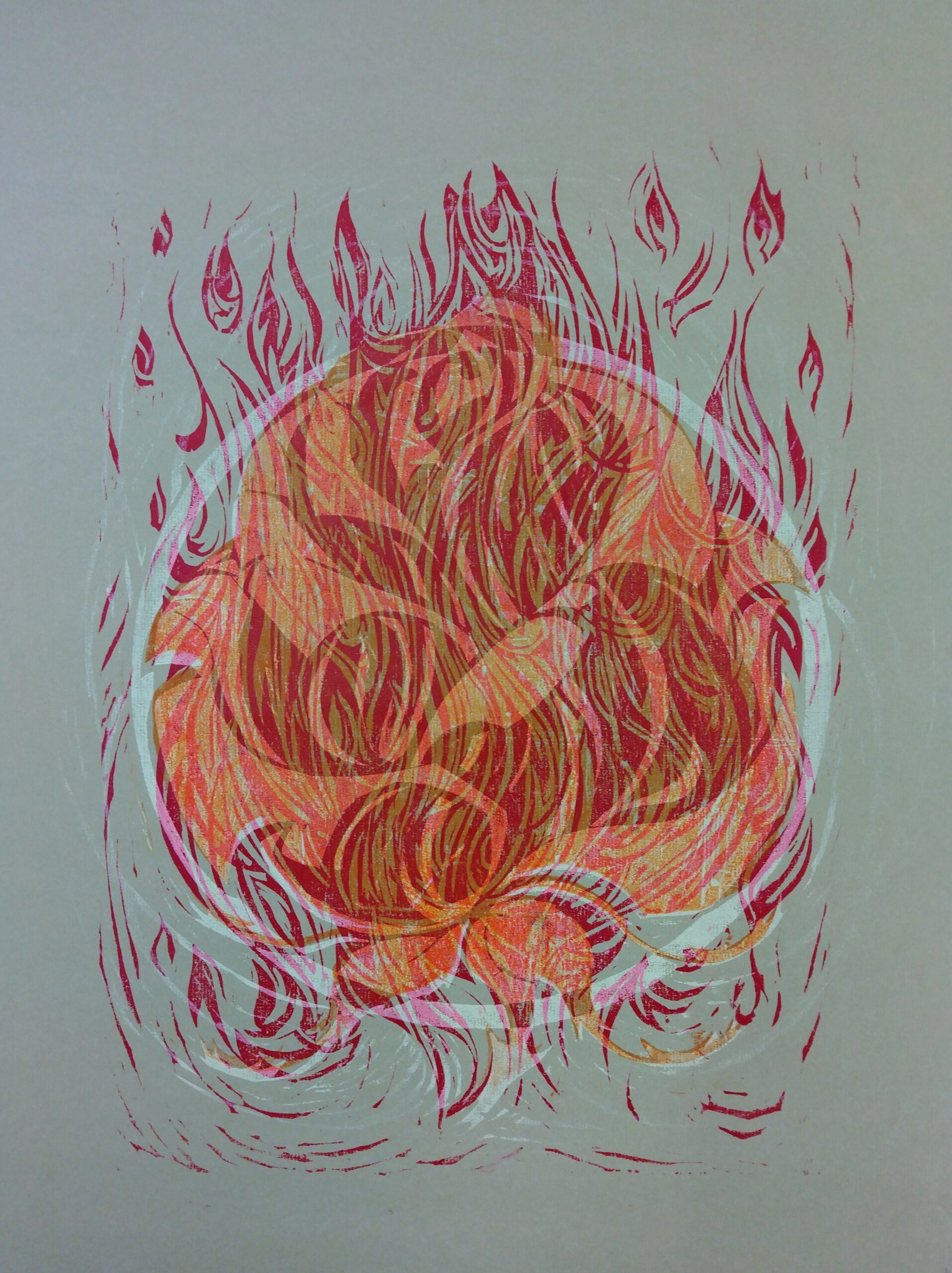
Lydia Breed’s life was full of color and line work. She had taken to landscapes, religious depictions and activist commentary. Her work, which was part of a movement that helped define Boston’s art scene in the 1950s, has become largely forgotten, her friend Kelly Slater said.
“She had a very distinguished art career,” Slater said. “But until recently her role (in the Boston print scene) was overlooked because women were not given credit for what they did and all the history used to be about the men in the movement. Renee Covalucci, who is with the Boston Printmakers, has really been working to promote Lydia’s legacy because it’s been somewhat overlooked.”
Slater is now part of a group working to preserve Breed’s legacy and artwork. Her art will be on display at the Unitarian Universalist Church of Greater Lynn through the end of October.
“Lydia had been a part of the congregation since she was a baby, and she died at 94,” Slater said. “It’s really just a privilege to highlight all of the work Lydia accomplished and just encourage people of the church to learn more about her.”
Breed was born in Lynn and later became a long-time Swampscott resident. After graduating from the Massachusetts College of Art with a bachelor of fine arts, she became a founding member of the Boston Printmakers, a small group of senior students and faculty from MassArt and the Boston Museum School.
She exhibited with the Boston Printmakers from 1948 to 1965, establishing herself as an artist within the movement. Arthur Heintzelman collected her prints for the Boston Public Library’s Print Collection, where her work remains part of the permanent collection.

Breed was also a member of the New England Sculptors Association, Copley Society and the Art Guild of Marblehead.
“She was always willing to teach an art class,” Slater said. “I knew her as a sculptor…She did a little bit of everything.”
Breed later became an art teacher in the Boston school system and worked as an illustrator with author Verna Hill Bayley on books including “Martin and Judy.”
Breed, a fifth-generation member of the Unitarian Universalist Church of Greater Lynn, had wooden sculptures and prints displayed throughout the congregation.

The current display features pieces such as “Why Not Now,” depicting hands reaching toward words from Charles Albert Tindley’s 1900 gospel hymn “I’ll Overcome Someday,” which became a protest anthem of the Civil Rights Movement in the 1950s and 1960s. Breed carved out the words “Oh Lord we’ll join hand in hand. We’ll join hand in hand. Someday hand in hand.”
A Yin and Yang woodcut represents the universe as a circle, with two colors coexisting while remaining separate. Breed traveled to Japan, and she was open to philosophies and theologies throughout her life, Slater said.

Another religious piece is Breed’s “7 Days,” which uses Roman symbols for the days of the week, represented by the sun, moon and five planets that gave the days their names.

The mosaic tiles were salvaged from the Rose Memorial, which once stood outside the Nahant Street Church. The Tree of Life background is carved from a single ash pew from the Lynn Universalist Church. The small scallop shell is also carved from an oak from the Lynn church’s pew. The seeds are carved from elm and popular pew seats from the Lynn Unitarian Church and the Swampscott Universalist Church respectively.
“She was open to considering and respecting all religions,” Slater said. “We have a print of the Torah, a print of a profit, a nativity scene.”
Nature was also a recurring theme in Breed’s work, like in her color woodcut Motif #2 Rockport, which shows images of fishing buoys with sunshine glistening on the still floats not in use.
An opening reception was scheduled for September 27 but due to inclement weather it will be rescheduled to a later date. The public, however, is welcome to view the work at no charge October 4 from 3 to 5 p.m., October 13 from 6 to 8 p.m. and October 18 from 4 to 6 p.m.