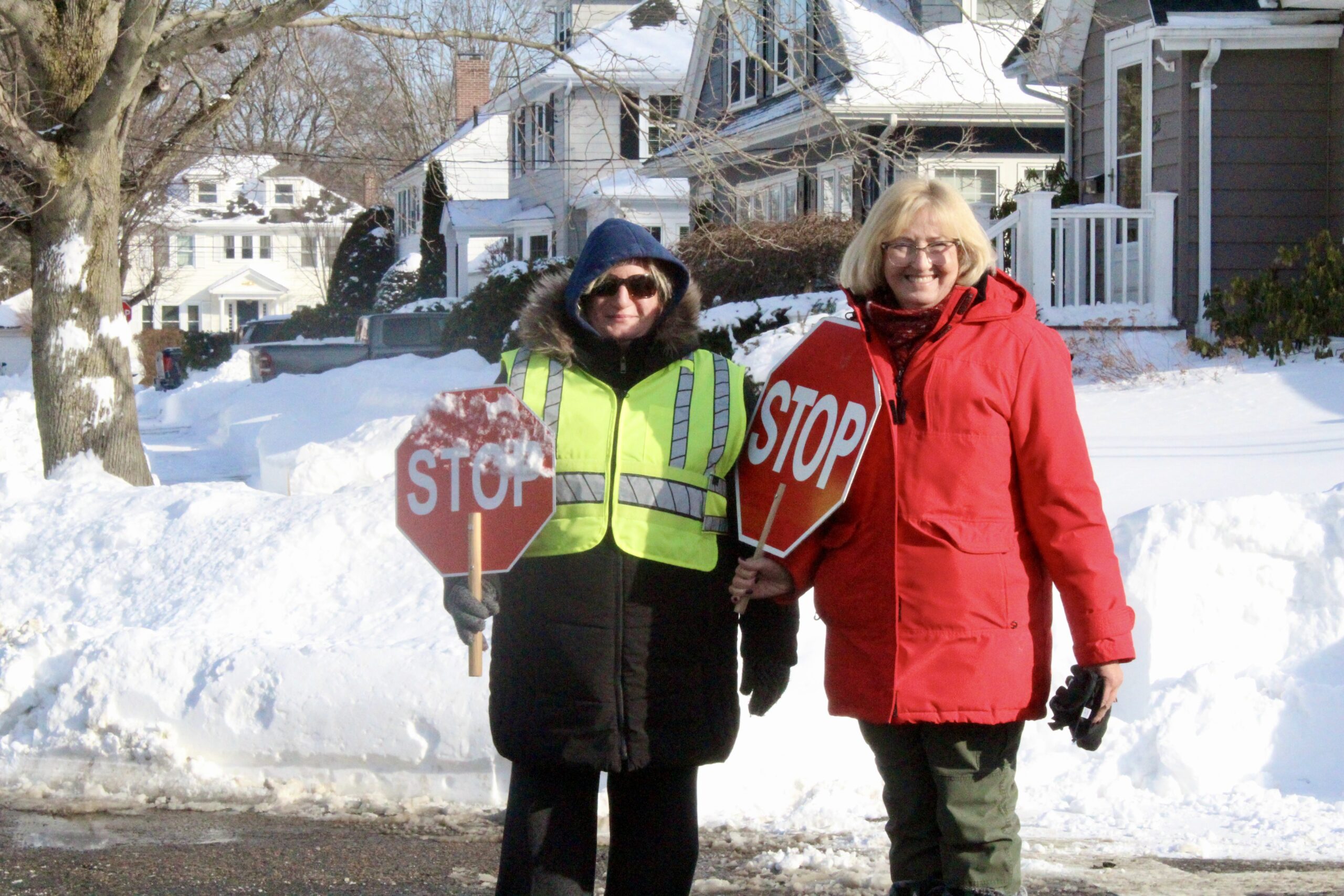
Rose Kelley has been a crossing guard in Swampscott for four years. Each day, she can be found at the elementary school in her reflective vest, directing traffic and ensuring students cross safely.
“It’s about the kids,” Kelley said.
Friday, February 6 marks National School Crossing Guard Appreciation Day, which honors the men and women who help students travel safely to and from school. Swampscott has 14 crossing guards stationed around the town’s elementary and middle schools, and School Resource Officer Brian Wilson said the community appreciates them all.
Wilson joked that when he had to substitute for Kelley for two months, he “was not as good.” He called Kelley a “field general.”
At school dismissal, Kelley can be seen directing cars to the appropriate areas, moving traffic along and making way for students. While the scene may seem chaotic in the moment, Kelley – and parents – appear to enjoy the daily interactions.

“It’s for the kids,” Kelley said.
For Alexandra Karounos, the position was a perfect fit, allowing her to manage her own children’s school drop-off and pick-up. She has served as a crossing guard for two years and works near Orchard Road.
“It’s about the community,” Karounos said.
Both Karounos and Kelley also work inside the school as lunchtime resources.
“It gives us extra time with the kids,” Kelley said. “The kids know they’re safe.”
According to the Traffic Safety Store, the presence of trained adult crossing guards significantly reduces vehicle-pedestrian collisions and near misses near schools. The organization cites a 20% to 50% reduction in child pedestrian injuries. Wearing reflective vests and carrying stop signs, guards act as high-visibility reminders for drivers to slow down and remain alert for student pedestrians.
In a town like Swampscott, where many students live within walking distance of school, crossing guards also help teach children safe crossing behaviors.
Even though they work only about two hours a day, Swampscott’s crossing guards are out in all conditions, during the freezing winters as well as the sweltering summers.
“It’s all so the parents know they’re safe,” Kelley said.