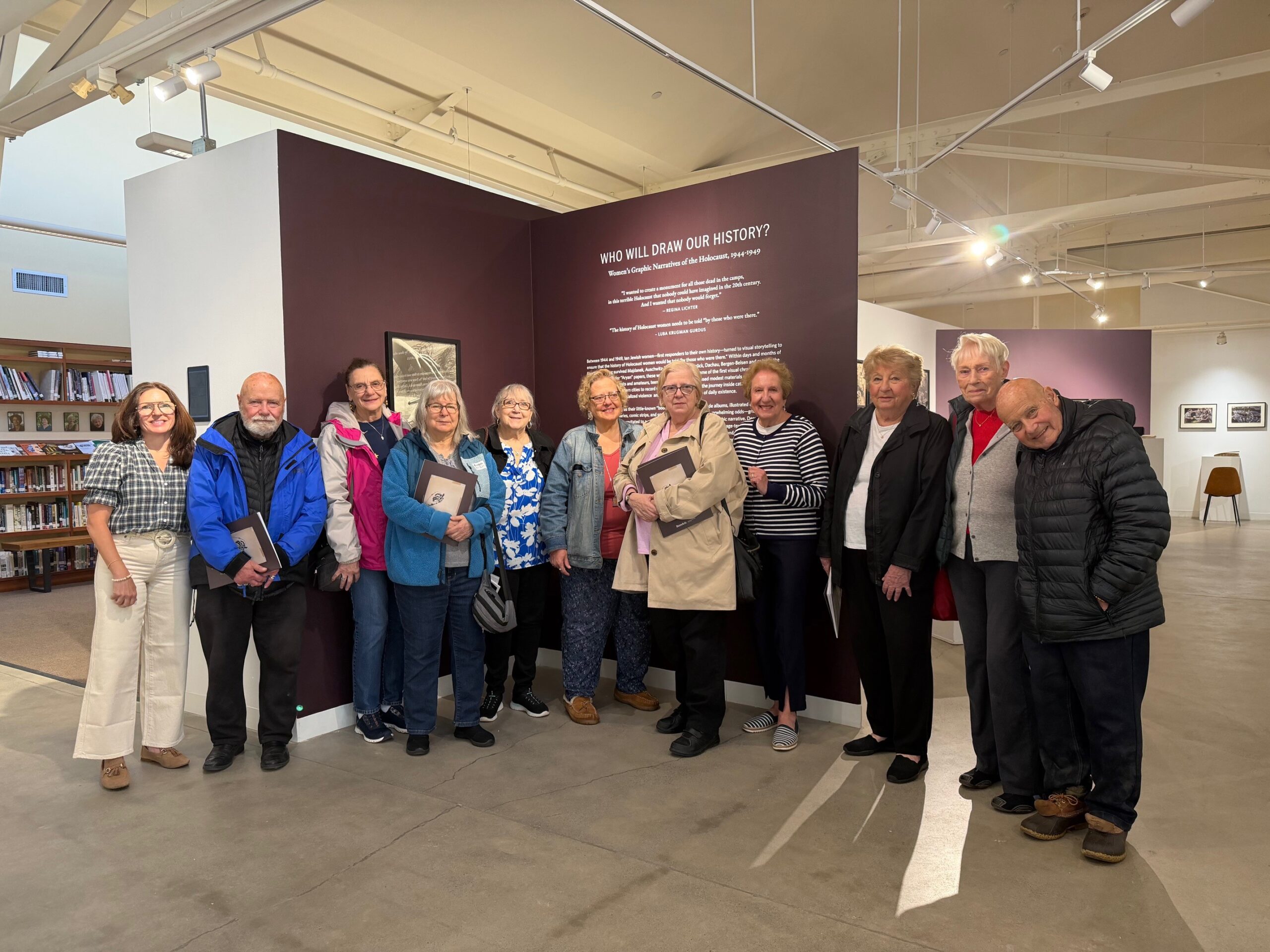
A group of Senior Center folks took a trip to Brandeis University on Tuesday to visit the Knizick Gallery and its exhibit on Holocaust survivors.
“The trip was a success. The bus was full. We had a great group of members who were engaged and excited to go,” said Senior Center Administrave Assistant Jeannie Patz, who attended the trip.
The exhibit, “Who Will Draw Our History? Women’s Graphic Narratives of the Holocaust, 1944-1949.” Dr. Rachel Perry guest curated the exhibit with Rosalie and Jim Shane Curator and Arts Coordinator Olivia Baldwin. Swampscott resident Amy Powell is the assistant director at the Hadassah-Brandeis Institute, one of the supporters of the exhibition.
The gallery introduces ten Jewish women who survived Majdanek, Auschwitz-Birkenau, Ravensbrück, and outside the Warsaw ghetto under “Aryan” papers, who days after their liberation started to record their memories in images and words.
The featured artists are: Lea Grundig (1906-1977), Luba Krugman Gurdus (1914-2011), Mária Turán Hacker (1886-1967), Edit Bán Kiss (1905-1966), Regina Lichter-Liron (1920-1995), Ella Liebermann-Shiber (1927-1998), Ágnes Lukács (1920-2016), Zsuza Merényi (1925-1990), Elżbieta Nadel (1920-1994) and Zofia Rozenstrauch (1920–1996).

“Between 1944 and 1949, scores of survivors created graphic narratives of their personal and collective experiences under NAzi persecution because they believed that, as Luba Krugman Gurdus insisted, ‘The history of Holocaust women needs to be told ‘by those who were there,’’” the exhibition catalog written by Perry reads. “These artists crafted their testimonies with their public in mind, selecting moments that could attract and hold attention, that could show the Holocaust’s progression through recognizable turning points…Their chronicles foreground women’s embodied experiences of trauma, forced labor, sexual and sexualized violence and maternal loss and familial separation that male survivors rarely documented.”

“Who Will Draw Our History?” brings together the “books of memories,” which includes wordless novels, handmade albums, pictorial diaries and illustrated books.
“It’s very heavy content material to take in,” Patz said. “It was very moving and powerful. The artwork and the volunteer, the docent that took us through, did an excellent job and really connected the art work to the experiences of the women and their experiences in the ghettos and concentration camps.”