Swampscott resident Richard Frenkel explored how automation, globalization and public policy have reshaped wages, proposing a universal basic income as a way to address growing economic inequality.
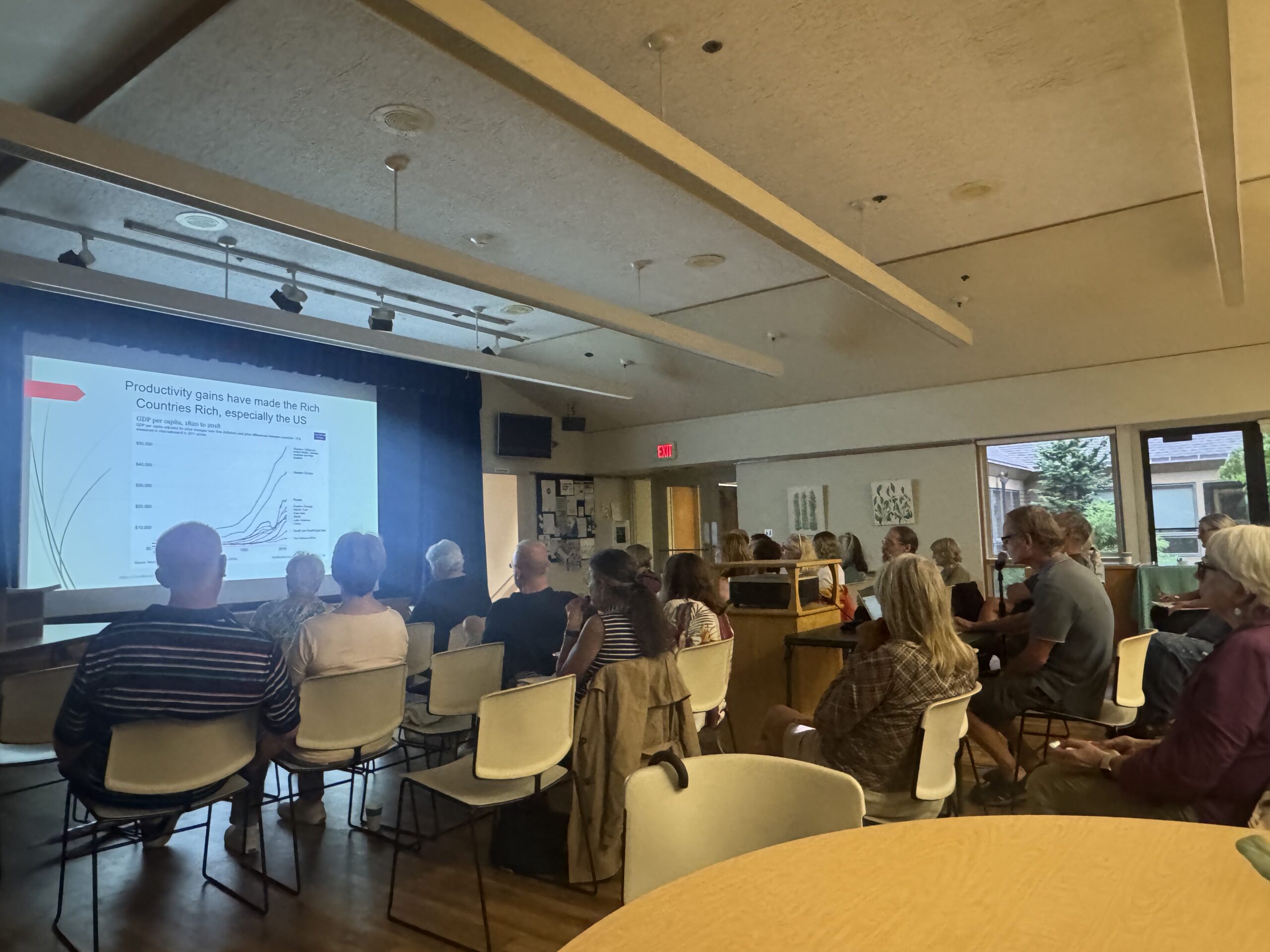
Frenkel presented his book “Shares in America” during a talk on Tuesday at the Unitarian Universalist Church of Greater Lynn. “Shares in America” presents data-driven evidence on widening economic inequality and the trends weakening the connection between work and earnings. Frenkel explores the solution of a universal basic income, which would guarantee income to every American with a direct share of national prosperity.
“We hear about how ‘trade is hauling out manufacturing in the Midwest’ and how ‘our jobs are going to immigrants’ and that sort of thing. I really wanted to get just a big picture of how things are working in terms of the economy,” Frenkel said. “I wrote ‘Shares in America’ because I was shocked with what I learned about the rise of income and wealth inequalities in the United States and also increasingly because we’re at a unique moment in economic history. We really need to think about this.”
Frenkel, who previously managed an IT company, opened his presentation by examining how the technological revolution has contributed to the nation’s widening economic divide and how new advancements, like artificial intelligence (AI), will continue to disconnect the wealthy from the poor.
The economy has shifted from a time when roughly 80% of Americans worked in agriculture to just 1% today, Frenkel said.
“Productivity gains have made us rich,” Frenkel said, noting that in poorer countries people have to live on less than $7.50 per day and in the “U.S. the GDP per person was over $80,000 per year in 2023.”
But within the U.S., income and wealth remain highly unequal.
“If all national income were evenly distributed, every household would have about $200,000 income,” Frenkel said. “The wealth inequalities are even more skewed. The Top 1% own a third of all the wealth in the United States…The bottom 50% has essentially no net worth. It really is true that three men have more wealth than the bottom half. It’s a very skewed distribution.”
Frenkel argued that automation has contributed to wage stagnation and a widening wealth gap. While trade and immigrants do not have as big of an effect as many tend to believe, according to Frenkel, he did note that political policy and machinery reducing the need for labor have taken a big toll on the wealth gap.
As AI becomes more widespread, Frenkel said increased automation will further reduce demand for certain types of labor, shifting more income from wages to corporate profits.
“As a result, income and wealth inequality are back up to Gilded Age levels,” Frenkel said. “Money inequalities are amplified in this trend.”
That’s where Frenkel’s case for universal basic income comes in. Frenkel’s “Shares in America” proposal would provide every American with a guaranteed income funded through a direct share of national prosperity, which he argued would reduce poverty, stabilize the economy and expand consumer spending.
“Universal basic income is a payment made to every adult citizen, say $1,000 per month…The whole idea is that it would be a supplement to income,” Frenkel said. “Think of it as Social Security. Everyone gets the payment, regardless of income. UBI lets us all share in the growth of the economy and in increasing productivity.”
Frenkel acknowledged his proposal would require higher taxes for some but argued most households’ net income would remain unchanged because the tax increase would be offset by the universal basic income payments.
He also added that the tax money raised does not necessarily go straight back to people’s pockets. Instead “there’s some leftover, enough to shrink the deficit by $4.5 trillion over ten years.”
“We can very well afford it,” Frenkel said. “This shows how UBI doesn’t affect our capitalist market engine.”
Frenkel pointed to others who have called for the universal basic income initiative as well, including a conservative economist in the ‘60s, former President Richard Nixon, Dr. Martin Luther King Jr., and political commentator Andrew Yang, who briefly ran for president on the idea of universal basic income in 2020.
More recently, technology leaders including Elon Musk and Sam Altman have expressed support for some form of universal basic income.
Altman even backed a study that provided a $1,000 monthly check to low-income participants. The results, published in 2024, showed that workers could save 1.3 hours per week with the additional money. The research and insight manager of the study, Karina Dotson, even suggested that the additional check allowed participants to meet their basic needs, which pushed them to give up some of the additional income to caregiving, leisure, learning and entrepreneurial initiatives.
“There’s a lot of rich people that are for this,” Frenkel said. “It’s definitely not a class thing. It’s something we need.”