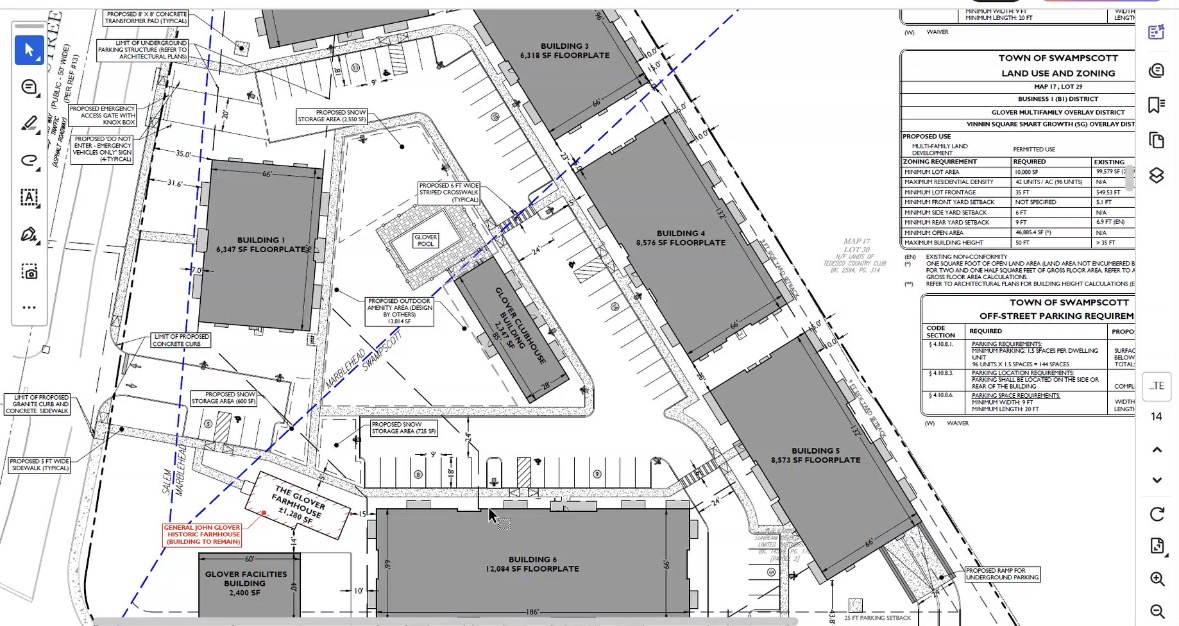
The Tree Committee is proposing a set of guidelines for the Planning Board to incorporate into its rules and procedures, while the Climate Action and Resilience Committee is developing a similar rubric.
The guidelines are meant to promote actions that reduce greenhouse gas emissions and ensure tree plantings and removals are considered in new developments. The Climate Action and Resilience Committee is also developing a points-based rubric to evaluate new building projects, encouraging designs that prioritize environmental sustainability and long-term resilience.
“We sat down at the Tree Committee and said ‘this is how we would like to evaluate new development plans from the point of view of trees,’,” said Tree Committee Chair Richard Frenkel. “Instead of loading this onto the Planning Board, it makes sense for committees, which have interests, to review that. We prepared a couple of rubrics.”
Until now, only the Swampscott Fire and Police Departments had explicitly been asked to weigh in on plans, according to Frenkel. While the Tree Committee and Climate Action and Resilience Committee’s recommendations are not binding, they “mark a new level of intercommittee cooperation in Swampscott.”
“It’s advisory,” Frenkel said.
The Tree Committee’s rubric evaluates the number and density of new trees, awarding points for parking lots that exceed minimum planting requirements and preserve or include mature trees.
The rubric also emphasizes species selection, favoring native plantings, “Swampscott accepted trees” and a diverse mix of species.
In addition to improving air quality, trees provide shade and help manage stormwater runoff.
The town lost 139 acres of tree canopy between 2010 and 2023, according to Frenkel. The impact is compounded as mature trees are removed and replaced with smaller ones.
The rubric also evaluates the overall design of a development, including proper spacing from infrastructure and the placement of trees to shade buildings, sidewalks and paved areas.
“We talked about the heat island effect,” Frenkel said.
Trees help mitigate the urban heat island effect by providing shade and preventing direct solar radiation from heating impervious surfaces such as asphalt.
The Climate Action and Resilience Committee’s proposed rubric would award points to projects that are fully electric, avoid fossil fuels, and incorporate high-performance building envelopes and energy recovery ventilation systems.
The rubric also awards points for on-site renewable energy and storage, such as solar panels or roofs designed to accommodate future solar installations.
The guidelines also call for all parking spots to be EV-ready.
“There should be a number of high speed charging stations equal to 10% of parking spots or 10, whichever is less,” reads the guideline for residential ev-charging stations.
The proposed rubric would also give projects points for having other capabilities, including on-site retention for once in a generation storms, green infrastructure such as rain gardens, permeable paving and tree canopy preservation or expansion.
“The rubrics will be published on the town’s website and developers can look at them when there’s a request for a review by the Planning Board,” Frenkel said. “We’ll evaluate them and give our advice to the Planning Board.”