Residents came and went from Swampscott Elementary School on Thursday night to review and discuss the town’s draft master plan, including its vision, goals, and strategies.
Swampscott is in the process of updating its master plan, which will guide the town’s objectives from 2026 to 2036. On April 3, 2024, the Select Board appointed a Master Plan Committee to work with town staff and the Metropolitan Area Planning Council (MAPC) to shape a roadmap for Swampscott’s growth, policies, and improvements over the next decade.
The committee has met six times, and Thursday night’s event was the third forum for the overall town, according to Carlos Montanez, the principal planner with MAPC. A resident survey received 385 responses and generated more than 1,800 open-ended comments.
“Between the committee meetings, the open forums and the survey, we have a lot of rich data,” Montanez said. “Tonight is the culmination. This is a preview of what’s going to come out in the draft plan.”
The plan is set to be released in December or January during a joint Select Board and Planning Board meeting, Montanez said. There will also be another online comment period to allow for further refinement before the finalized version of the plan.
“It’s to get that further refinement,” Montanez said.
Attendees could leave written comments on display boards and use green or red dots to show agreement or disagreement with various proposals.
The open space and recreation received the most green dots, especially around items like expanding and connecting the Rail Trail as well as enhancing and maintaining the beaches. One person suggested the town should “build a proper water safety crew and plan.” Another asked why the beach safety focus was only on Kings Beach rather than others, particularly Fisherman’s Beach.
The climate and sustainability goals and strategies board also received a lot of positive feedback. Many supported the 2025–2030 hazard mitigation plan, particularly the idea of funding seawalls and green infrastructure for stormwater management. Others liked the idea of addressing pollution sources at vulnerable beaches.
“We can’t even talk about climate resiliency if we continue to prioritize car transportation,” one person wrote on a sticky note. “No more parking.”
Over on the transportation board, MAPC has seven goals and 23 strategies, such as leveraging the adoption of the MBTA Communities zoning as well as expanding walking, biking and rolling connections throughout the town.
“Some of the current bike lanes on Humphrey are very unsafe,” one sticky note read. “People need to ride on the sidewalks.”
Residents also agreed with the historical and cultural resources goals, particularly around the goals of preserving and protecting Swampscott’s rich historical heritage and expanding the documentation of historic resources and narratives.
For the public facilities and services board, MAPC goal of upkeeping facilities through strategies like ensuring comprehensive financial planning, promoting a strong educational system, and building partnership or hiring social workers for a co-response unit with the Police Department. Residents also called for a clearer communications plan for major infrastructure projects and community initiatives.
“Please use the town website more as the place to go to for all town info, especially meetings and events,” one resident wrote. “Not everyone uses social media.”
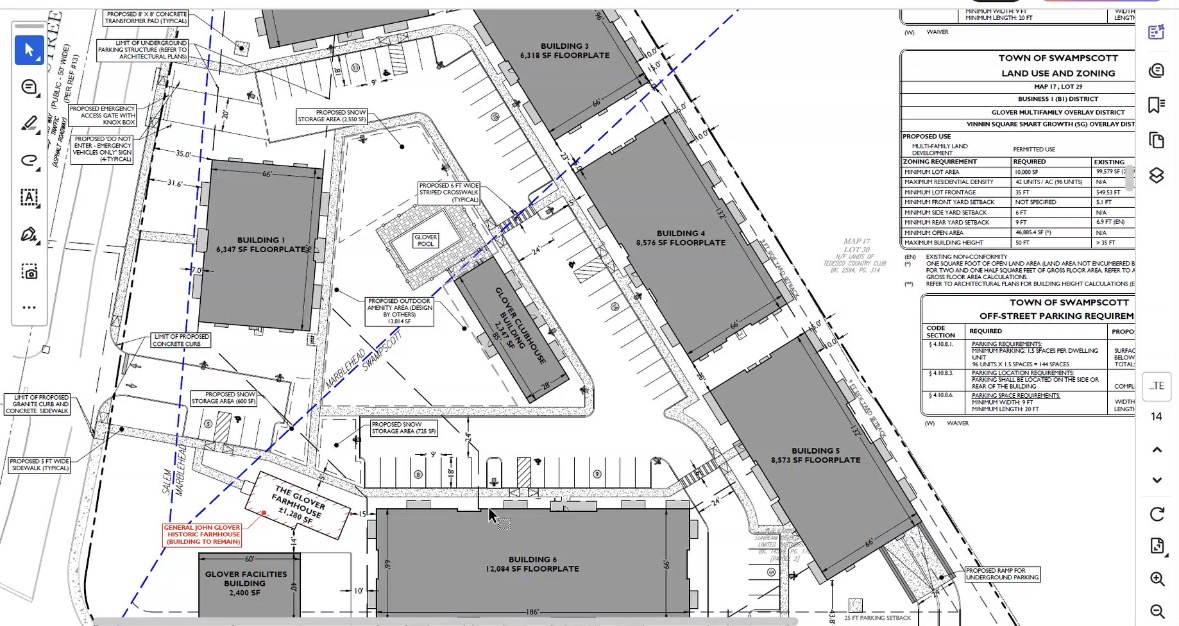
The economic and community development board drew mixed reactions, with several red dots signaling disagreement. Residents did not all agree with the idea of revising zoning to encourage mixed use development in areas like Vinnin Square and the commuter rail station. Others did not like the idea of encouraging the development of a new hotel and lodging options.
“No hotel on Redington St.!” one note read, while others suggested better parking at the train station or to have more diverse businesses.
Land use and zoning was the other board with red dots. The disagreements all centered around the goal of managing development while promoting diverse and affordable housing. MAPC had listed the strategies of updating zoning to allow for wider housing mix, prioritizing redevelopment and affordability, and managing the Community Preservation Act at a big-picture level.
“We need to prioritize our history as a ‘draw’ to the town and resident pride,” a note read.
Montanez and his team also presented six “high level” components that would serve as vision statements for the master plan. The statements centered around core identity, sustainability, public spaces, neighborhoods, economic vitality and governance.

Another board showed how the topics do interact with each other, and a final board showed the ten year horizon and what projects should take priority and be started first over other plans. The board listed climate infrastructure and resilience as a top priority with multimodal safety, zoning reforms and diverse housing coming in the near future. Fiscal stability was seen as a priority now through year seven of the plan.
Even though MAPC does have a draft on the boards, Montanez said he will still work in residents’ opinions from the forum.
“I’m going to do a summary summation of this,” Montanez said. “Some of these are high priorities but with revising things might go down a little from the dots and the comments.”