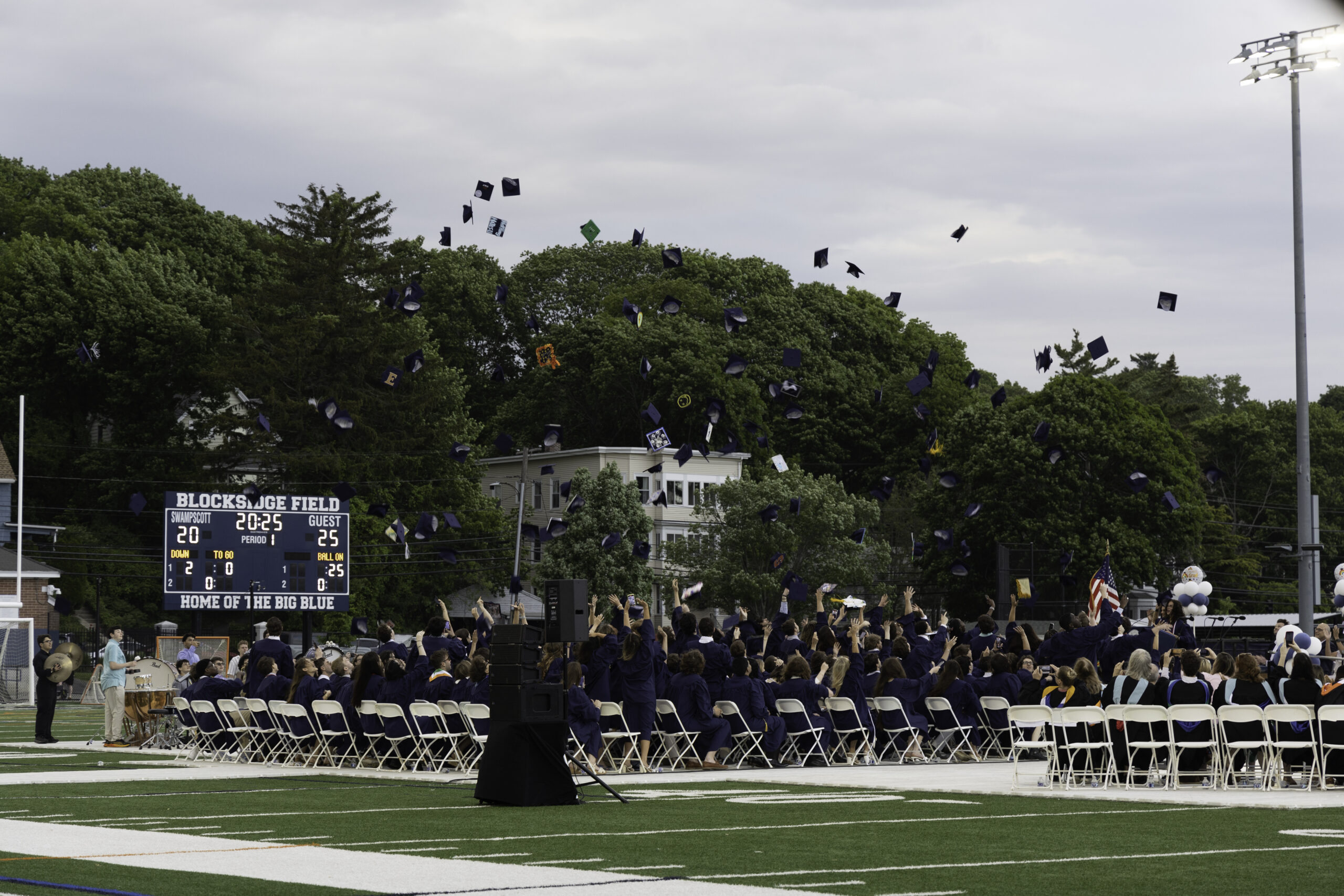
The School Committee unanimously approved a one-year plan to certify the class of 2026 for graduation under the state’s new competency-determination rules.
Director of Teaching and Learning Sarah Kent presented the rules to the School Committee at a meeting Thursday, November 20. She said the changes stems from last year’s statewide ballot question. Massachusetts voters approved ballot question No. 2 during the 2024 election, which resulted in the elimination of the Massachusetts Comprehensive Assessment System (MCAS) exam as a graduation requirement.
“When MCAS was put aside by the vote in November, the school district assumed a lot of responsibility DESE (the Department of Elementary and Secondary Education) used to have for us,” Kent said. “Students need both a competency determination as well as graduation requirements to graduate.”
Before the November 2024 vote, passing MCAS was the automatic route to competency determination. The statewide testing system measured student achievement and identified schools that needed additional support. Students had to pass the exams in English language arts, mathematics and science to earn a high school diploma in Massachusetts.
Now districts must certify that students have mastered the state’s ninth and tenth grade standards in English language arts, math and science through coursework, assessments or other locally approved methods.
Kent emphasized that “there’s a bunch of different pathways to get a competency determination,” and she explained that Swampscott’s seniors occupy a unique transition year because many still hold MCAS scores from before the rule changed.
Under the district’s written competency determination plan for the class of 2026, seniors must still meet Swampscott High School’s local credit-based graduation requirements through twelfth grade as well as a state-required competency determination tied to mastery of ninth- and tenth-grade standards in English, math and science.
The plan the School Committee approved on Thursday states students can earn competency in each subject through a qualifying MCAS score from 2022 through November 2024 or by demonstrating mastery locally, with options including passing an assigned intervention, earning an i-Ready score equivalent to level a student is expected to have by the end of tenth grade, passing a course final assessment, or passing the next course in a sequence.
Districts are now required to prove alignment between courses and standards through intensive mapping, Kent said. However, she also warned that state guidance may still evolve.
“This might not be in our hands in a couple months,” Kent said, noting a the K-12 Statewide Graduation Council that was formed in January to examine graduation requirements and develop a new framework.
The proposal also outlines added support for students with disabilities and multilingual learners, transcript-review options for transfer students, and a formal appeals process led by a competency review panel, with the superintendent serving as final arbiter.
Martha Raymond, the director of student services, said that she respected the promising features of the plan, particularly for students with disabilities. She did highlight, however, challenges with local certification as well.
“I appreciate the flexibility of the multiple pathways. I think that is going to be really important,” Raymond said. “There’s going to be subjectivity to the other ways that we now decide if you’re competent or not, MCAS was to remove some subjectivity.”
Raymond noted that common assessments “are going to be critical” to reduce disparity between classrooms.
Kent said multiple coursework paths and IEP-based supports remain available, but some students may still graduate with certificates rather than diplomas if they cannot demonstrate mastery.
Chair Amy OConnor noted that removing MCAS as a graduation gatekeeper “obviously places more responsibility on each school.”
Committee Member Suzanne Wright said that after this school year, the district will need earlier checkpoints.
“It seems like for the majority of kids going forward, you’re going to have a couple dozen kids that you’re going to have to focus on for like eleventh and twelfth grade,” Wright said.
To avoid overhauling multiple grade levels at once, Kent said Swampscott is limiting its plan to this senior class. She noted that other districts in the state are “trying to do it all at once, and it’s not working out so well.” The Swampscott School District is set to have a broader approach for future classes.
“I’m actually worried about the class of 2027 a little bit more than the class of 2026,” Vice Chair Glenn Pastor said, arguing the next cohort will face fewer MCAS “safety net” options.