On Wednesday, the Swampscott Public Library hosted The Men of Essex County, a public lecture highlighting the often-overlooked Battle of Menotomy and the role of local Patriots in America’s fight for independence.
The event was organized by the Swampscott Historical Commission, the Swampscott Historical Society, and the “Save the Glover Farmhouse” Preservation Effort. Guest speaker Michael Ruderman, a historian from Arlington, delivered the presentation. Ruderman has researched and presented local and colonial history since 1977, and he recently published The Forgotten Battle of Menotomy in the Spring 2025 issue of American Heritage.
Ruderman focused on the Battle of Menotomy, fought on April 19, 1775, which many consider to be the first day of the American Revolutionary War. He explained that while Lexington and Concord are well-known, the day’s most intense and deadly fighting took place in Menotomy (now Arlington) as thousands of colonial militia “ambushed” the retreating British troops.
Ruderman noted that at least 701 men from Essex County fought at Menotomy. Among those killed was Abednego Ramsdell, a resident of an area that was then part of Lynn and would later become Swampscott. Ramsdell reportedly left a duck hunting outing to join the Patriot militia when the word reached the area.

“A lot of people don’t realize that Swampscott has a Revolutionary history,” said Nancy Schultz, chair of the Swampscott Historical Commission. “We had one of our very own sons die. There is Revolutionary War history here, especially with the Glover house as well.”
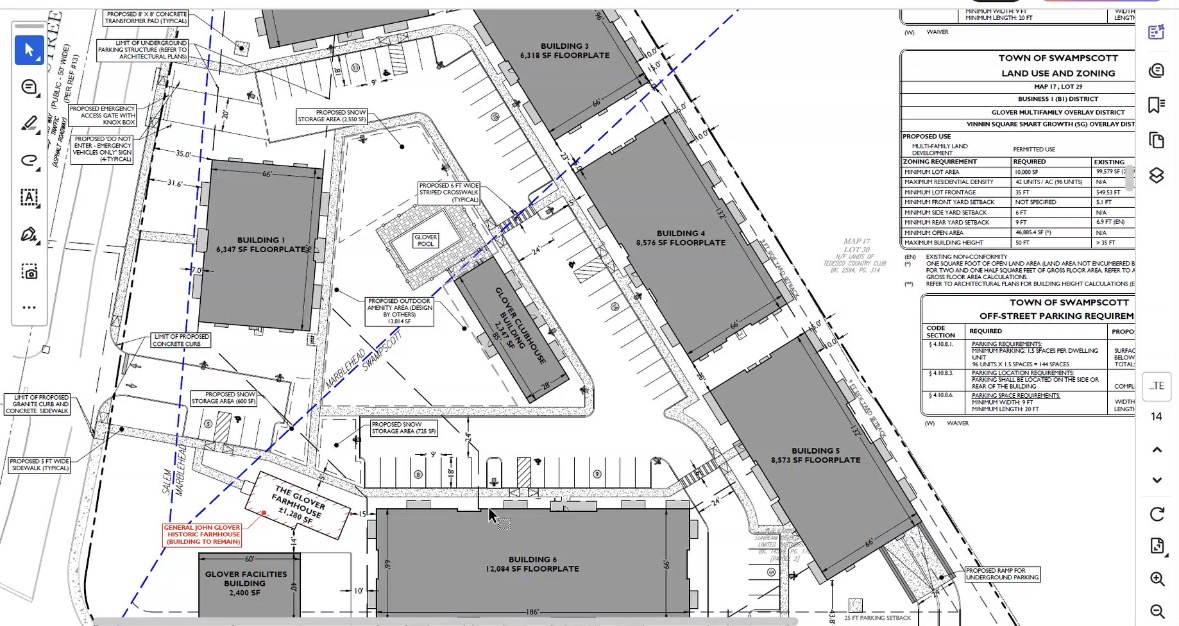
The evening also served as a reminder of the ongoing fight to preserve local history, including the more than 250-year-old Glover Farmhouse on the Swampscott-Marblehead border, which is currently at risk of demolition.
General John Glover, a Revolutionary War hero, is best known for leading the regiment of sailors and fishermen that ferried George Washington and his troops across the Delaware River in 1776. After the war, he was rewarded with the farmhouse, which remains a significant piece of local and national history.

Ruderman, who was born in Duxbury and now lives in Arlington, reflected on how his surroundings have shaped his lifelong connection to local history.
“I live in Arlington close enough to the center of town that if it were really quiet and somebody came galloping through on horseback, I would have heard,” he said. “So I’m surrounded by it.”
His interest in the past, he explained, began early. “That goes back to my first instances of falling in love with local history, when I realized that just from the town that I happened to grow up in (Duxbury). I was surrounded by Mayflower descendants,” Ruderman said. “My best friend, John, whose last name was Bradford, was descended from the John Bradford, 14 generations earlier.”
To Ruderman, history is not something distant or abstract.
“History has always seemed to me not something in a book, not something that has been lost,” he said. “It’s as real as the person sitting next to you or where the marker in the town (is), or walking along saying ‘That house, right over there. That was the scene of the bloodiest fighting on the day that America began.’”
He was referring to the John Russell House in Arlington, where some of the most brutal, close-range combat of the Battle of Menotomy took place. Unlike the more widely recognized battles of Lexington and Concord, the fighting in Menotomy happened street by street and house by house, with many civilians caught in the crossfire.
The full presentation of The Men of Essex County is available to watch on the Town of Swampscott’s official YouTube page.