This is a contribution from a Swampscott High School student, as part of the Swampscott Tides Big Blue Student News selection.
Story by Sasha Fafel
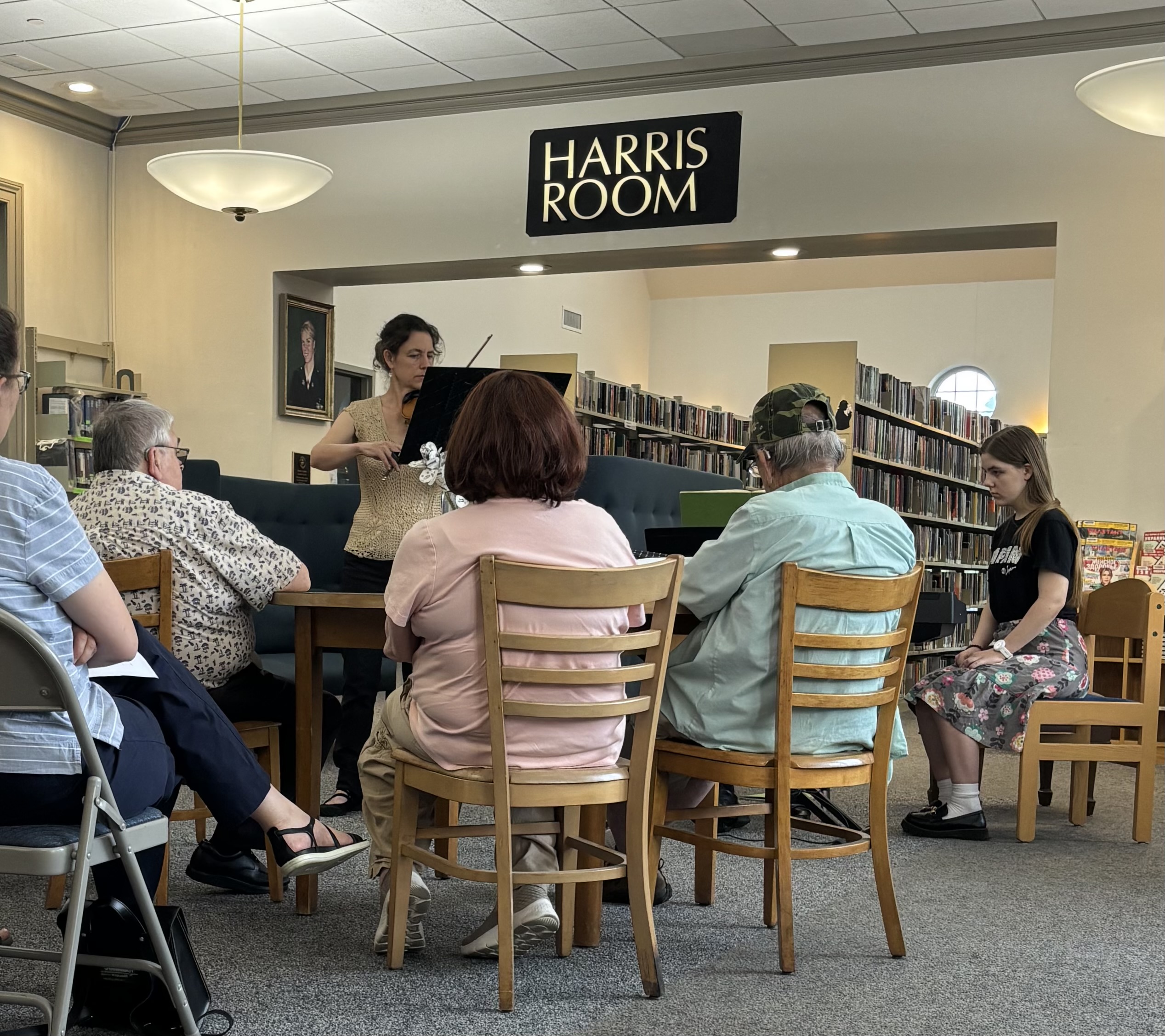
The Swampscott Public Library hosted a short recital Thursday night with violinist Rachel Shiryayeva and pianist Lenny Cavallaro.
The event was part of the library’s overall celebration for its summer reading kick off. The two musicians performed “Sonata #40 in B-flat for Fortepiano and Violin, K. 454” by Wolfgang Amadeus Mozart and “Sonata #10 in G Major for Fortepiano and Violin, Op. 96” by Ludwig van Beethoven.”
The two upbeat and emotional sonatas attracted around 30 listeners in the library’s Raymond Room.
Swampscott resident Shiryayeva is a teacher at the North Shore Community College, and she plays in the North Shore Philharmonic and North Shore Chamber Music Society, according to the recital’s program. Shiryayeva has been in the musical world for most of her life.
Her daughter Alyona Shiryayeva, who acted as Cavallaro’s page-turner on Thursday, is following in her footsteps as well, Shiryayeva said.
“I have played here (in the library) before in a trio,” Shiryayeva told the Swampscott Tides. “I was very happy to do this again, and it was so nice to have a big audience.”
Shiryayeva explained that there are not many venues to perform at on the North Shore, so it is meaningful to have the opportunity to perform anywhere, like the library. Shiryayeva and Cavallaro have been colleagues for nine years and they hope to continue performances at the library, Shiryayeva said.
Cavallaro is an adjunct professor at Wentworth Institute of Technology, according to his website. He is also a composer and author, where he “was a top prizewinner in the J.S. Bach International Competition for Pianists and subsequently performed that composer’s Six Parititas to the highest critical acclaim in Carnegie Recital Hall,” according to the library’s program.
Cavallaro, in occasional remarks throughout the recital, explained the histories of the sonatas to the audience, as well as his love for Beethoven’s work.
The two sonatas showcased how violin-and-piano music evolved from the late 18th century into the 19th century. While both works are written for the same instruments, they reflect different musical styles and artistic goals.
Mozart’s sonata is divided into three movements: a slow introduction that gives way to a brighter, more lively section, a lyrical movement that highlights a graceful conversation between the violin and piano, and a cheerful, energetic finale.
Written nearly three decades later, Beethoven’s sonata expands the expressive possibilities of chamber music with richer harmonies and greater emotional depth. The work emphasizes lyricism and subtle expression, beginning with a gentle, flowing melody before moving through moments of quiet emotion and playful energy, ultimately ending with a peaceful conclusion.