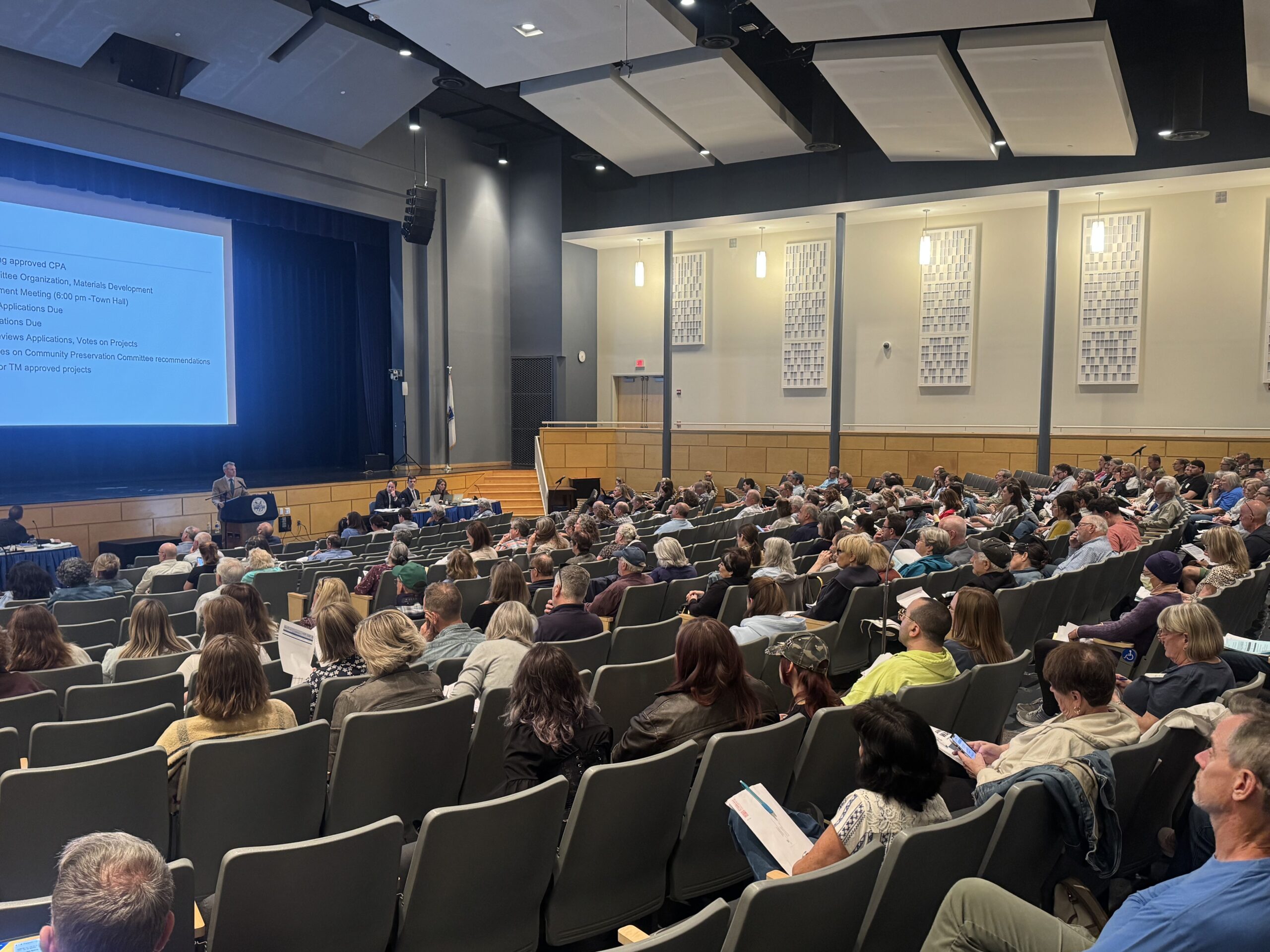
Swampscott held its first night of Town Meeting on Monday. It was Ryan Hale’s first time acting as town moderator.
“Town Meeting has a very long history,” Hale said. “It’s our duty to uphold that tradition.”
Voters acted on 14 articles, completing the warrant in one night. Here’s a summary of the outcomes.
Article No. 1
The Town Meeting started with reports from boards and committees.
Naomi Dreeben introduced the Community Preservation Committee and the purpose of funding projects through the Community Preservation Act.
The Cultural Council reviewed events that the group has supported, like Salem Film Fest 2026, Delvena Theatre Company events and an AAPI Art and Education Workshop. Upcoming events include Swampscott High School’s video installation, a musical instrument lending program, native lawn alternatives talk and the Harbor and Marine Festival
Anneka Kumli spoke for the Community Life Center Feasibility Study Task Force, encouraging people to fill out a survey to gauge interest in a potential new life center for all ages. The survey can be found at https://www.surveymonkey.com/r/swampscottclc1.
The Planning Board also reviewed its priorities. The Master Plan, which “is good for the next ten years,” will be voted for adoption on June 17, according to Angela Ippolito. She also shared information on Vinnin Square. The Hawthorne property will have its short-term leasee open July 1, as the Select Board discusses long-term plans starting in June, according to Joseph Sheridan, who also discussed the Humphrey Street zoning proposal that will be brought up in the fall.
Article No. 2
Town Meeting Members unanimously approved to approve bills from the prior fiscal years.
“This is an article that we have pretty much every year,” Finance Committee Chair Eric Hartmann said. “We use free cash to pay these invoices.”
They authorized the payment of $41,963.75. The bills are as follows:
- Parking Ticket Processing: invoiced on June 30, 2025 for $196.50
- Injured on duty Medical Claims: multiple invoices for $36,429.42
- Unemployment Claims: multiple invoices for $5,337.83
Hartmann said the medical claims, the largest expense, were an ongoing discussion over a few years and are now resolved.
Article No. 3
Town Meeting Members were asked to vote to amend various line items in the 2026 fiscal year budget, as recommended by the Finance Committee.
There was an amendment to the appropriation handed out to the Town Meeting Members based on information received from the Solid Waste and Recycling Committee contract negotiations. The funding was revised to transfer $330,000 from free cash to the replacement carts/parts line to purchase recycling carts in the current fiscal year.
“The town has been negotiating a new trash and recycling contract for a long time now,” Finance Chair Eric Hartmann said. “We will be moving away from having your own recycling bins and having a standard bin.”
The new contract begins July 1. Trash collection will become automated immediately, while recycling service will transition once the bin decision is finalized.
Hartmann said the options are to pay for the recycling bins outright through free cash, as recommended by the Finance Committee and later approved by Town Meeting members. The other options are to bond the cost over five years or lease the bins.
Town Administrator Nick Connors said officials are currently deciding between 65- and 96-gallon bins, though he suggested the larger option is more likely to avoid overflow issues. A 96-gallon bin is about three-times the existing barrels. Residents will also have the option to purchase a second barrel, as well as participate in a pay-as-you-throw program.
Wayne Spritz, a Select Board member and former chair of the Waste Advisory Committee, said the town will develop a take-back program, though residents can also repurpose their current bins for uses such as yard waste.
Almost all Town Meeting Members voted in favor, passing Article No. 3’s appropriations.
Article No. 4
Town Meeting Members approved a $87,041,794 budget for the 2027 fiscal year, a 4.9% increase to the 2026 fiscal year budget.
“This was again a very challenging financial season but also a collaborative one,” Finance Chair Eric Hartmann said. “There’s been numerous public meetings…where committees and boards worked collaboratively to the budget we have in front of you tonight.”
The Finance Committee amended its suggested appropriations ahead of the Town Meeting, following the information from the Solid Waste and Recycling Committee’s contract negotiations.
“The budget that was originally printed the warrant – when that was printed we didn’t know where that was headed,” Hartmann said. “Now we’re much closer to closing this deal, and we need to add an additional $206,980.”
While the funding for the solid waste costs in part comes from the tax levy, Hartmann noted that is approximate as the levy is set later.
Hartmann walked the Town Meeting Members through the budget, noting that it has “reduced but not eliminate the use of excess levy,” which is unused taxing authority from previous years.
“The cost of operating the town is growing at a rate that exceeds our regular growth,” Hartmann said. “The Finance Committee believes that the town needs to act now. on some of the opportunities we have to control our costs.”
Article No. 5
Article No. 5, which did get approved, was the first one that a Town Meeting Member spoke to suggest people do not vote in favor, suggesting that the money in the reserves.
“If you don’t need the money, don’t appropriate it,” Town Meeting Member James Andrews said.
The unused money returns to the Community Preservation Fund, according to Community Preservation Committee Chair Tom Dawley. He indicated that the percentages set aside, however, are required.
Article No. 6
Swampscott Finance Committee Member Gregory McDonald explained that this article increases the Recreation Department’s spending from $500,000 to $650,000.
Town Meeting Members unanimously passed the article.
Article No. 7
It was approved to accept $300,000 “or such other amount as made available by state legislation” to repair and construct streets.
State Rep. Jennifer Armini (D-Essex) announced in her newsletter that through this year’s Chapter 90 program, which provides direct funding to municipalities for road and bridge repairs, Swampscott can receive $435,737.33.
“Article No. 7 is a standard annual article,” said Finance Committee Vice Chair Erik Schneider. “These funds help offset local costs.”
Schneider said the article was written broadly so that the money can be used for any unforeseen construction needs.
Article No. 8
Article No. 8 was postponed, meaning no action was taken.
Article No. 9
Town Meeting Members approved $11,709,310 in borrowing for recommended capital improvement projects.
The vote was taken after an amendment failed to remove the line to appropriate $600,000 to make 89 Burrill St., the former Reach Arts location, accessible and fire protected. B’nai B’rith Housing’s construction would begin a year following funding, which is expected in the fall. Select Board Chair Katie Phelan noted that the location needs to be hospitable for the veterans to move in there and ensure its accessibility for long-term use.
The money comes from the general, sewer and water funds to pay for the costs of the projects, which impact the Department of Public Works, government facilities, school facilities, water, library and both the police and fire departments.
Schneider specifically called out the need for windows at the middle school as well as a new track at the high school.
“The existing track has reached the point where it is unsafe to use,” Finance Committee Vice Chair Erik Schneider said. “The Committee viewed this as an important investment in community infrastructure.”
Schneider noted that not advancing a project this year does not mean it does not have merits. The next phase of sewer work was not funded, as the current phase is not completed nor evaluated.
“That’s why it makes sense to delay that for a year,” Schneider said, adding the gym technology and middle school classroom spaces were also not recommended. “We have a long term capital plan and there are several projects on the horizon.”
Article No. 10
Select Board Chair Katie Phelan moved to postpone the article.
“This lateral bylaw has been on this warrant, on the prior warrant. We want to see this succeed,” Phelan said, noting there will be meetings on the issue in the coming months.
The bylaw will come onto the warrant again in the fall, Phelan said.
Article No. 11
Town Meeting Members voted to prohibit the use of rodenticides. The article is for public property and not private property.
“This article originated from a citizen petition,” said Select Board Member Mary Ellen Fletcher. “As a town, we already have a policy. This article will codify the policy.”
The Swampscott Fire Department began using SenesTech’s EVOLVE rodent birth control devices in late September, supported by Speak Up for Animals and Director of Facilities Max Kasper. EVOLVE is non-toxic and made from food-grade ingredients, unlike second-generation anticoagulant rodenticides (SGARs) and other poisons.
EVOLVE devices are safer than poisons like SGARs, which, while effective at killing rats, also pose risks to pets, children, and wildlife. Even more so, as rats are prolific breeders, the poison doesn’t stop them from coming back.
Other animals, such as squirrels and chipmunks, tend to ignore the EVOLVE boxes, according to Speak Up for Animals’ Deb Newman.
“The very predators that are keeping (rats) down are being harmed by SGARs,” Newman said.
Article No. 12
Article No. 12 was the citizens’ petition version of Article No. 11. Since Article No. 11 passed, a vote on Article No. 12 was not needed.
Article No. 13
Deb Newman, who had submitted the petition to prohibit the sale of foie gras, postponed the article.
Article No. 14
After much opposition from Town Meeting Members, Article No. 14 failed. Town Meeting Members voted to not restrict open wood fires in Swampscott.
The idea of community bonding and family time around the bonfire was brought up by many.
Dr. Lawrence Block, who had proposed the article and said it was approved during his time on the Board of Health, took the opposition to the article similar to when his cardiology patients would not take his advice, he said. He noted his want to inform the public though.
“This article is not to ban all fires in town,” Block said. “It is to ban wood fires based on health effects.”
Block noted that particles in smoke travel into people’s lung airways, causing inflammation and attributing to heart attacks, strokes and other health issues.
“Wood smoke is extremely carcinogenic,” Block said. “It is extremely toxic.”
Town Meeting Member Barrie Atkin expressed her support to the article due to the affect she’s experienced.
Massachusetts state law forbids all outdoor wood burning from May 1 through January, except for “small cooking fires.”
“Unfortunately people find loop holes,” Block said. “The state leaves enforcement up to individual towns.”
Article No. 14 had suggested neighbors would have to “take photos of the fire and those responsible for it and submit a complaint with the photo, the time and date of the violation and the offender(s) names to the Board of Health for review.”
One Town Meeting Member said she felt targeted by the article since her family’s traditions and cultures rely on “live fire cooking.”
Block said 22 towns and cities in Massachusetts have banned backyard campfires. He noted “no other coastal town” – outside of Swampscott and Nahant – allow beach fires.
“There’s no way you can possibly have a fire in Swampscott without adversely affecting the health of a neighbor,” Block said. “I’m not saying we shouldn’t have fires. The fact is there’s alternatives.”